


14 hours ago
Showing posts with label Christian Living. Show all posts
Showing posts with label Christian Living. Show all posts
The first time I heard the term “apologetics” was in a worldview study I did with my youth group when I was 15 years old. I had always been solid in my faith, but I remember that study being so interesting and helpful as I considered how to communicate the “reasons for the hope within you” (1 Peter 3:15). I went through another round of being interested in apologetics in my early 20s, listening to various podcasts, and reading books like The Case For Christ.
However, my relationship with apologetics quickly became a bit complicated the deeper I got into it. I became aware that there are different approaches to apologetics, and they are not all necessarily biblical. I witnessed different apologists critique methods used by others, which forced me to think through those things myself. Under the surface of all this was the sneaky suspicion that all this apologetics knowledge was not actually helping me - though it was interesting, I never needed apologetics to convince me that my faith was reasonable, and I was developing a feeling of inadequacy. I was never going to be able to remember all this information in an actual conversation about my faith.
I kind of veered away from my interest in apologetics over time, but after I became a mom and my kids grew older, the apologetics conversation became present everywhere I turned. “We need to be teaching kids apologetics!” was being shouted from every corner, and I didn’t necessarily disagree. But my uneasiness remained.

My husband and I have talked through this topic extensively, and I always feel able to communicate my thoughts so well in our private conversations, but it’s challenging to be as clear in writing or as honest in other conversations about the pitfalls I see in some aspects of apologetics. In this article, I am going to try to outline my thoughts, as a layperson who is very much not an expert on the subject. I don’t want to come across over-critical, or as if I don’t like apologetics at all! I think it can be interesting to study apologetics and very helpful for some people, and I enjoy reading about apologetics from trusted sources myself. But I believe we need to approach modern apologetics with some foundational understandings, or we could end up doing some harm.
1. Apologetics cannot be the basis for truth.
This is the point I have the most difficulty in articulating, so bear with me.
For years I have read books and heard podcasts about the “reasonableness” of Christianity, or how it’s logically consistent, or how there is so much evidence for this or that being true. And I don’t disagree with any of that. At the same time, we need to understand that someone can have a belief that is logically consistent based on the available evidence, and that belief can still be untrue. A belief that is true will be reasonable and logical and have evidence behind it, sure, but those things aren’t what make that belief true.
The real question is, what is the source of truth? Is it only based on things we see in the physical world? How do we know the physical world is actually real and not just a simulation, as some argue? Where does logic even come from, and why does it work? I hope you see the dilemma.
Logic only proves the consistency of a line of thinking, it doesn’t prove something as true. Physical evidence can be interpreted in many ways, which is why our understanding of science and history is constantly shifting as new physical evidence comes to the surface. So how can we know anything we believe about anything is actually true?
There has to be something behind it all. Truth, with a capital T, comes from somewhere else, outside of evidence and logic - it has to have a source. A good apologetics method needs to recognize that everyone is ultimately relying on their underlying source of truth, and some “sources” are as shaky as whatever they can see with their eyes. Our understanding of truth, as Christians, should not be so shallow. As Christians, we understand that we can only know something is true insofar as it aligns with the only source of Truth, which is God Himself.
2. Apologetics approaches that argue without using the Bible are actually undermining the Bible.
There is an ad going around Instagram as we speak for a “theology” curriculum that proudly proclaims that it will teach your kids how to argue for Christianity without using the Bible. I know people who have purchased it. I wonder if they understand how insidious such an approach is.
I went to a talk by Renton Rathbun recently, and he used an illustration that makes the point well, so I’m going to borrow it. Suppose you have a ruler you are using to measure something. You aren’t too sure about that ruler though, and feel like you need to confirm the measurement. So you get another ruler, and measure again with that ruler. Which ruler has now become the standard for an accurate measurement? The second ruler has become the standard by which you are now measuring the first. You can introduce as many new rulers as you want, and each new ruler becomes the standard by which you are evaluating all the others. At some point you need to pick THE standard and measure all the rulers by that one standard.
When we are “measuring” Christianity so to speak, God’s Word is the standard by which all else must be measured. If we are using something else to “confirm” the Bible, whether it be archeological evidence, logical arguments, etc., we are now setting those things as the standards and judging God’s Word by them!
This mistake is so subtle and unfortunately so common. For the Christian, God’s revelation of Himself through the special revelation of the Bible must be the standard. We cannot set the Bible aside and argue from lesser “standards” or we are undermining the very source of truth that God has given us. And as I tried to establish in the first point, without God Himself as the source of truth, which He has given to us most clearly in His Word, there is no way to know what is true at all.
3. Apologetics cannot protect your children from unbelief.
I want to reiterate here that I think it is definitely a good thing to teach our kids apologetics, especially a good apologetics method that is based on the understandings I tried to communicate above. I wouldn’t want to discourage someone away from apologetics altogether. I think apologetics can be encouraging for the Christian, and I think knowing how to communicate apologetic information to unbelievers can remove some barriers to them believing the gospel. We are told to “destroy arguments and every lofty opinion raised against the knowledge of God” (1 Cor. 10:5), and apologetics is certainly part of that.
My concern starts to arise when I see moms put too much faith in apologetics as the thing that is going to keep their child in the faith. You see this with statements like “Your kids need to study apologetics so their faith isn’t destroyed in college.” The attitude seems to be that if we give our kids enough evidence, they will have to believe, and then they will be protected from arguments from atheistic professors or friends. This is making apologetics into an idol. “Evidence” is a shaky basis for belief because someone can always bring different “evidence” that can seem very persuasive.
Like me, I am sure you have watched many a wonderful debate between Christian apologists and atheists. If presenting the evidence was all it took for someone to believe, we should see people falling on their knees and repenting right there. But clearly apologetics arguments are not enough to make someone believe.
We forget that salvation only comes from a work of the Holy Spirit on someone’s heart. Our faith does not come from an airtight argument, it comes from God Himself, by His grace. Without His conviction, we all would continue suppressing the truth in unrighteousness (Romans 1:18). God is the one that draws us (John 6:44), and the Holy Spirit convicts us of sin (John 16:8). When we are saved no one can snatch us out of Jesus’s hand (John 10:28-30). God is the one who grants us repentance, and the work He begins in us will be carried out to completion because He is faithful (Philippians 1:6).
We can give our kids all the evidence in the world, but it doesn’t guarantee their salvation and endurance in the faith - and that’s scary for us moms! But even so, it is a mistake to put our hope in apologetics. We must bring our kids before God in prayer for their salvation and spiritual growth, and tell them the gospel every chance we get. This doesn’t mean we don’t prepare our kids to face the secular arguments they will encounter throughout their lives, we should do that. But our faith needs to be in the One who will hold them fast, not in the arguments of fallible men. As we teach our kids apologetics, it should be from the perspective that God will help them persevere to the end.
4. Apologetics conversations should always lead to the gospel.
What is the purpose of apologetics, anyway? Is it mainly for Christians, or unbelievers? The word “apologetics” comes from the Greek “apologia”, which means to give a verbal defense. This is a biblical idea, since we are to demolish arguments that are raised against the knowledge of God and take every thought captive to Christ (2 Cor. 10:5). I think there is a role here in apologetics for encouraging the Christian, but what about in conversations with unbelievers?
This brings me back to the discouragement with apologetics that I developed years ago. I would listen to extremely smart apologists communicate the evidence, I read alot of books, and I often found myself rehearsing imaginary conversations in my mind. How would I communicate the evidence if I were to get into this kind of conversation? There was no way I could remember it all! It left me feeling that I could never succeed in apologetics without memorizing vast amounts of information and being ready at a moment’s notice for a debate, and that was intimidating.
In the end though, I was overcomplicating it. Apologetics should not be used to beat someone over the head with information. The end goal needs to be to communicate the gospel - and that is much less intimidating.
I’ve seen some expert apologists tear down every argument raised in debates with unbelievers, but that in itself does not bring a person to faith. We must use apologetics in conversations with unbelievers not to “own” the debate, but to bring them to the gospel message. If we forget this part, what is it all for anyway? We might look all smart and knowledgeable, but the souls of our opponents are just as lost. If we never get to the gospel, apologetics is not glorifying God, it is just glorifying ourselves.
There is an art to this, and I won’t pretend I have ever done it well in conversation myself. But it hurts me when Christian apologists are criticized (by other Christians, even) for not sticking to the debate because they tried too hard to preach the gospel in the conversation. The gospel (not apologetics) is the power of God for salvation to those who believe (Romans 1:16). Any apologetics instruction that does not also teach us how to point every conversation back to the salvation that only comes through faith in Jesus Christ - well, it’s just missing the whole point.
I’m writing this article from the perspective of a Christian mom, and I know that is also most of you who will be reading this. I hope I’ve convinced you to take care when choosing apologetics books for yourself or your kids. It takes discernment to evaluate apologetics sources for what they are holding up as the source of truth - some are obviously excluding God’s Word, but watch out for subtle undermining too. I hope I’ve also been able to remind you that our faith is in God, not in apologetic arguments, and the gospel is the key to the whole thing.
To close this article, I’ll share a few books I’ve read, in whole or in part, that approach apologetics in the way I’ve argued for here. I’m also including a couple podcasts. I wish you wisdom and discernment as you learn more about apologetics, and I pray you remember to keep Christ in the center, “in whom are hidden all the treasures of wisdom and knowledge"(Colossians 2:3).
Recommended Resources:
Expository Apologetics by Voddie Baucham - Baucham shows us how Paul himself argued apologetically in Scripture, and how to have biblical apologetics conversations ourselves.
The Ultimate Proof Of Creation by Jason Lisle - Lisle communicates problems with different approaches to apologetics, before giving us the “ultimate proof” - I haven’t finished this one yet, but I can see where he is going with it enough to recommend it.
Every Believer Confident by Mark Farnham - If you aren’t sure how to bring an apologetics conversation back to a personal level that leads to sharing the gospel, I think this is the definitive guide for how to do that.
The Renton Rathbun Show by Renton Rathbun - Rathbun actually has a PhD in Apologetics, and he has thought through the deeper issues with certain apologetics approaches. I’ve really been enjoying his conversations on this podcast.
Wretched Radio by Todd Friel - Particularly look for the “Witness Wednesday” episodes. Friel goes to college campuses and has actual conversations with students, including apologetics arguments, but in a gentle and compassionate way that always brings the student to the good news of salvation. This podcast is the main resource that has given me confidence that I could handle a witness opportunity with an unbeliever. Also see: Ray Comfort at Living Waters on Youtube.

My friend sat across from me in the coffee shop, drinking something hot from a big glass mug. I took a nibble from my pumpkin bread and choked back a few tears as I prepared to confess something.
It had been a very rough start to the year, and I knew I was in desperate need of prayers for strength. I was discouraged, at a loss for how to help in a difficult situation. I knew I need the Lord’s wisdom and prayer support through this hard time. Aside from my family, I had a handful of friends who I absolutely knew would remember me in their prayers if I asked them.
As I sat across from one such friend, I voiced the thing that had been burdening me ever since this hard season started. I had a feeling about the sort of people I could count on to pray for me, and in contrast, the people that didn’t give me the same confidence. That’s when an uncomfortable thought occurred to me.
Was I the kind of person that my own friends could count on to pray for them?
I had to admit to myself that I probably was not that kind of person for those dear to me. I was often sympathetic in the moment, might shoot up a quick prayer, but then would forget.
The healthy kind of shame came over me. I don’t want to be that way anymore. I want to be the kind that can be counted on to pray and not forget.
Thus began my 2025 mission of figuring out a prayer routine and system that will help me become a true praying woman. Not just praying in the moment, but someone who will hold my loved ones up in prayer over and over again, until their needs are answered one way or another. Someone who will “pray without ceasing” (1 Thess. 5:17).
I’ve been slowly working through books on prayer, and writing myself reminders to pray in my phone. I been writing out prayer requests, and trying to become fluent at praying Scripture, and falling in and out of the habit of morning prayer too many times. Striving to figure this whole thing out, alternating between success and failure.
I think learning to become a woman of prayer is probably always like that, trying, and failing, and trying again. But hopefully becoming more and more faithful along the way.
In light of my ongoing desire to become better at prayer, I wanted to share one of the prayer resources I’ve picked up recently. I am excited about trying it as another way to guide and reinforce a habit of prayer in my life.

The Pour Out Your Heart Prayer Journal is a book I’ve been eyeing for almost a year now, and when my copy arrived in the mail it was so pretty that I just stared at it for a couple months, not wanting to mess up the beautiful cloth cover and pristine pages. But then I realized that was silly. This journal was meant to be used, to be messed up, to get fingerprint smudges on the pages and coffee drips on the cover over many years of use. So I finally jumped into it.
Most prayer journals that I have explored in the past have pages with room to write praises, thanksgiving, confession, and requests. This journal does as well, but the way it is organized is more conducive to years of use, and being able to easily find previous prayer requests.
The first section is devoted to spending time pondering the gospel - with pages to write out verses and any other quotes while remembering all the Lord has done for us in prayer.
The next section is similar, with pages to remember God’s promises in Scripture. The encouragement is to focus on the character and promises of God before presenting our requests to Him. As someone who tends to rush through prayer too often, I appreciate the built-in reminders and guidance for slowing down and pondering while praying Scripture.

Then we come to what you would typically expect in a prayer journal, pages for recording prayers for specific things. There are pages for praying for unbelievers, for the Church, and for Christ’s Kingdom to advance through missionaries and ministries. Next there are pages for praying for specific loved ones, and finally, pages for praying for yourself.
The final section is for recording God’s provision in answer to prayers. This section is meant to be used as you recognize God’s answers to prayer, or at the New Year as you look back and reflect on how God has worked throughout the year.
The back of the book holds a few pages with encouragement for prayer, and lists of possible verses to use in your prayers for each section. There are also some beautiful prayers included from saints from the past.
I love that the layout of this book is built specifically around remembering what God has done. Answered prayers cannot get lost in this journal because of how it is laid out. The pages for individuals are meant to be used with sticky notes so that as needs change, you can just swap out the notes. It’s a really smart system when you take a little time to understand it.

(Notice the water stain on the front of my journal. I’m learning to be okay with letting it get beat up!)
I have been laying aside time to pray each morning using this journal, and while I am still not as faithful to daily prayer as I aim to be, having all my prayer requests in one place, along with guidance for pondering and praise, is so helpful. I like having a place to write ongoing prayer requests and a system for keeping the same book for a long period of time. I look forward to using this journal for many years to come.
If you have a prayer journal, or some other system for keeping track of prayer requests and answered prayers, I would love to hear about it! Please share in the comments - I’d love encouragement and ideas, or to commiserate if developing a consistent prayer life is something with which you have struggled as I have!
Note: I received this journal for free from the publisher in exchange for an honest review.

I’m typing this on New Year’s Eve. The Christmas decorations are starting to feel like clutter, and there are still a few opened presents piled into random corners. I am choosing to ignore all of that, and I’m sitting next to our wood stove with a cheap mechanical paper and a list of New Year’s Eve questions.
I don’t think I’ve ever taken such intentional time on New Year’s Eve to reflect on the previous year, but if I’ve needed it any year, it’s this one. “Pick three words to describe this past year,” the paper commands me. My three words combined give an impression of the year that feels more negative than it actually was, but I don’t think I can change any of them.
Quiet. So many years can be described this way, but this is how the year felt internally for me. Not alot happened this year that was life-changing, there were no major events. We didn’t do anything very grand. We made outings of local sights, we played alot of games, we hung around here. We visited family, had dinners with friends, went to the pool, went roller skating, went on hikes. No huge vacations or parties or weekend trips. Just quiet. There is a subtle difference between “quiet” and “peace”, but I found this year that the first can lead to the second if you have the right perspective.
Disappointments. Alot of things did not go to plan this year. We had to cancel plans, shell out savings money for broken appliances, and subsequently rework our budget. We weren’t able to take a trip to see our dear out-of-state friends as planned, and that one hurt. We had some unexpected challenges that made me slow down and appreciate the time I have with my loved ones, because each day is a gift, but we don’t always notice that. Many things that happened this past year have reminded me that death can come for us at any time - and having that in mind shouldn’t be morbid, but should fix my eyes on things that really matter. Knowing God more, loving Him better, living “before the face of God” - coram Deo, something I learned from R. C. Sproul - these are pursuits that are never wasted. Disappointments remind us Christians that this world isn’t our ultimate home. We are just passing through.
“You have made us for yourself, O Lord, and our hearts are restless until they find their rest in You.”
-Augustine
Togetherness. Even though we didn’t get to do all the grand things this year, in the end, I think it was a good thing. We had to get a little more creative to plan fun things to do, and those things ended up being fun because of the people we were with, not the thing we were doing. I’ve appreciated more than ever having a happy, healthy family life, having friends we love, having extended family relationships that are a peaceful joy in our lives. Not everyone can say those things. These are true riches.
“Create a statement that describes this past year for you,” the paper prompts me.
I tap my pencil against my teeth, and hesitate. Creating a phrase to represent a whole year is no small task.
This is what I scribble down.
Disappointments are inevitable, but time is a treasure I can’t take for granted.
Lord, teach me to number my days, that I may gain a heart of wisdom.
Years ago, when I first started reviewing books for my blog, I read a book by a popular Christian author that I would have thrown across the room if I were the type of person to do that sort of thing.
The thing that made me so frustrated with the book was a particularly sappy description of loving Jesus in a way that made him sound more like an eager-to-please boyfriend. I have long hated Jesus-is-my-boyfriend language in books, because it is offensive to the very idea of a biblical love of God, and completely eliminates the idea the idea that we are to fear the Lord.
The fear of the Lord is an idea that alot of Christians have trouble understanding, and I relate to that struggle too. Now, loving the Lord, we think we understand that. Even the idea of having a reverence for the Lord is something that is simpler to comprehend. But fearing the Lord? Why do we need to fear Him if we know He loves us enough to die for us? Doesn’t perfect love cast out fear? Isn’t “fearing the Lord” more of an Old Testament thing? We know we don’t have to fear His judgement if we are in Christ, so what are we supposed to be afraid of? And are we literally supposed to be quaking in our boots, or does fearing the Lord mean something else?
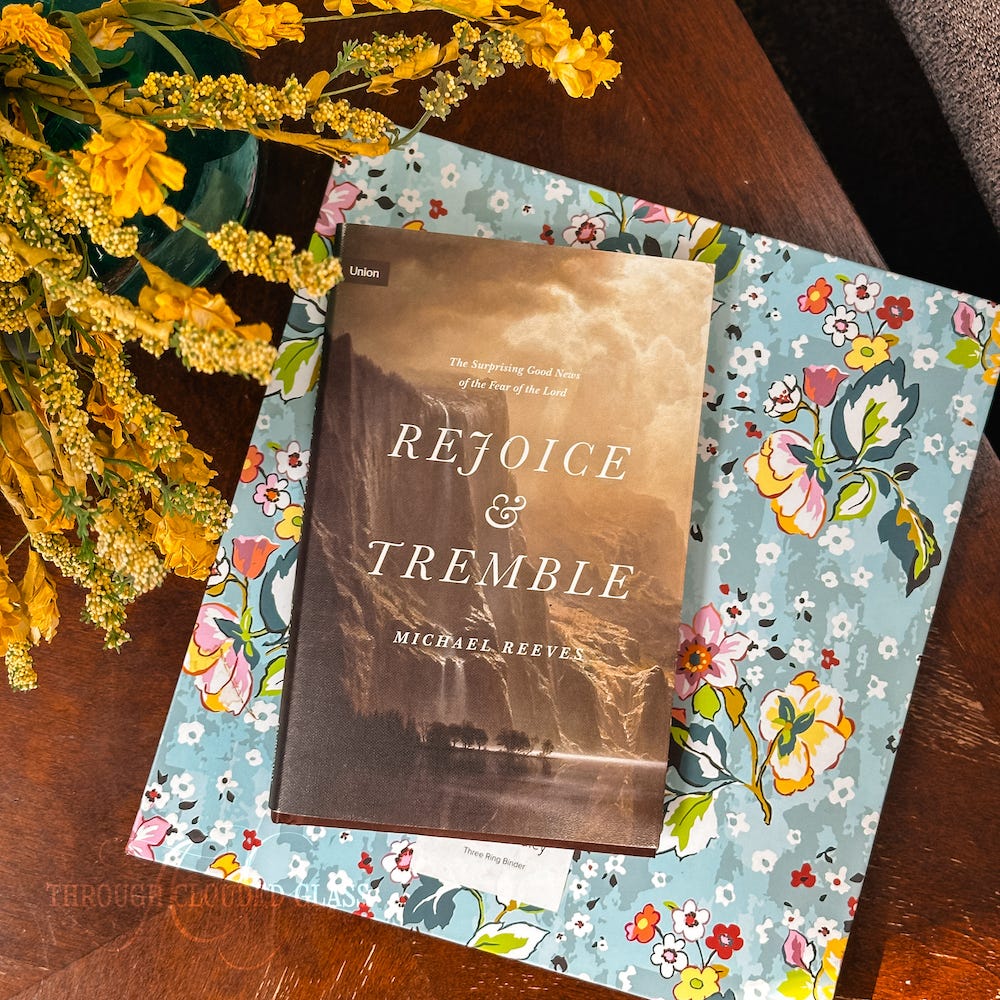
In Rejoice And Tramble*, Michael Reeves provides one of the most beautiful explanations for the fear of the Lord that I have ever read. He explains that properly fearing the Lord is a more full, complete idea than merely having a '“reverence” for Him, a word which Reeves calls not inaccurate, but nevertheless “anemic”. Fearing the Lord is not in opposition to loving Him - it instead describes the right sort of love we are to have for God, a love that trembles. It is a fear that is not joy-sucking, but joy-fulfilling. It is not a fear that causes us to cower or run away, but rather a fear that draws us to our awesome, fearful God.
“The Lord looks on the heart and is pleased when He finds it quaking in wonder, love, and praise…For the nature of the living God means that the fear which pleases Him is not a groveling shrinking fear. He is no tyrant. It is an ecstasy of love and joy that senses how overwhelmingly kind and magnificent, good and true God is, and that therefore leans on Him in staggering praise and faith.” pg. 67
One section that especially rung true for me is where Reeves explains the right fear of God as our Creator, but then reminds the reader that properly fearing God’s creative power is not enough with the understanding of Christ’s redeeming work for His own. Fearing God as Creator has always been the easiest way for me to understand the fear of God, because His power and might and infinite understanding are so obvious and awesome when viewed through His creation. But Reeves points out that we only rightly understand God as the Creator when we understand the work of Christ. We don’t have to earn the favor of our Creator, which is something that would lead us unto sinful fear since we all instinctively know it is impossible. No, Christ has earned salvation for us, and because of that we can truly enjoy the glimpses of God’s character that we see in creation.
“The fear that is ‘purely evangelical’ continually and wholly rests upon Christ’s redemption as sufficient, not our own works. It is not left wondering if our sins might outweigh Christ’s righteousness, or if Christ’s righteousness needs some topping off of our own efforts. It can therefore remain constant in dependent wonder, not terror. Indeed it’s wonder is only increased by the perfection of Christ’s redemption and the infinity of His grace toward such extreme sinners as us.” pg.99
We can have true pleasure in the work of God in creation when we understand Him not just a fearful, powerful Creator but also the one who is our Redeemer. A right fear of God is a fearful love, understanding His power and greatness as it stoops to rescue “ a wretch like me”. This great God, who created all things, also redeems us, and because of that all His works become more wondrous and joyful to us.
“‘Gazing upon the vast expanse of waters - looking up to the innumerable stars, examining the wings of an insect, and seeing there the matchless skill of God displayed in the minute; or standing in a thunderstorm, watching, as best you can, the flashes of lightening, and listening to the thunder of Jehovah’s voice, have you not often shrunk into yourself, and said ‘Great God, how terrible art thou!’ - not afraid, but full of delight, like a child who rejoices to see his father’s wealth, his father’s wisdom, his father’s power - happy, and at home, but feeling oh, so little!’” -quoting Spurgeon, pg. 79
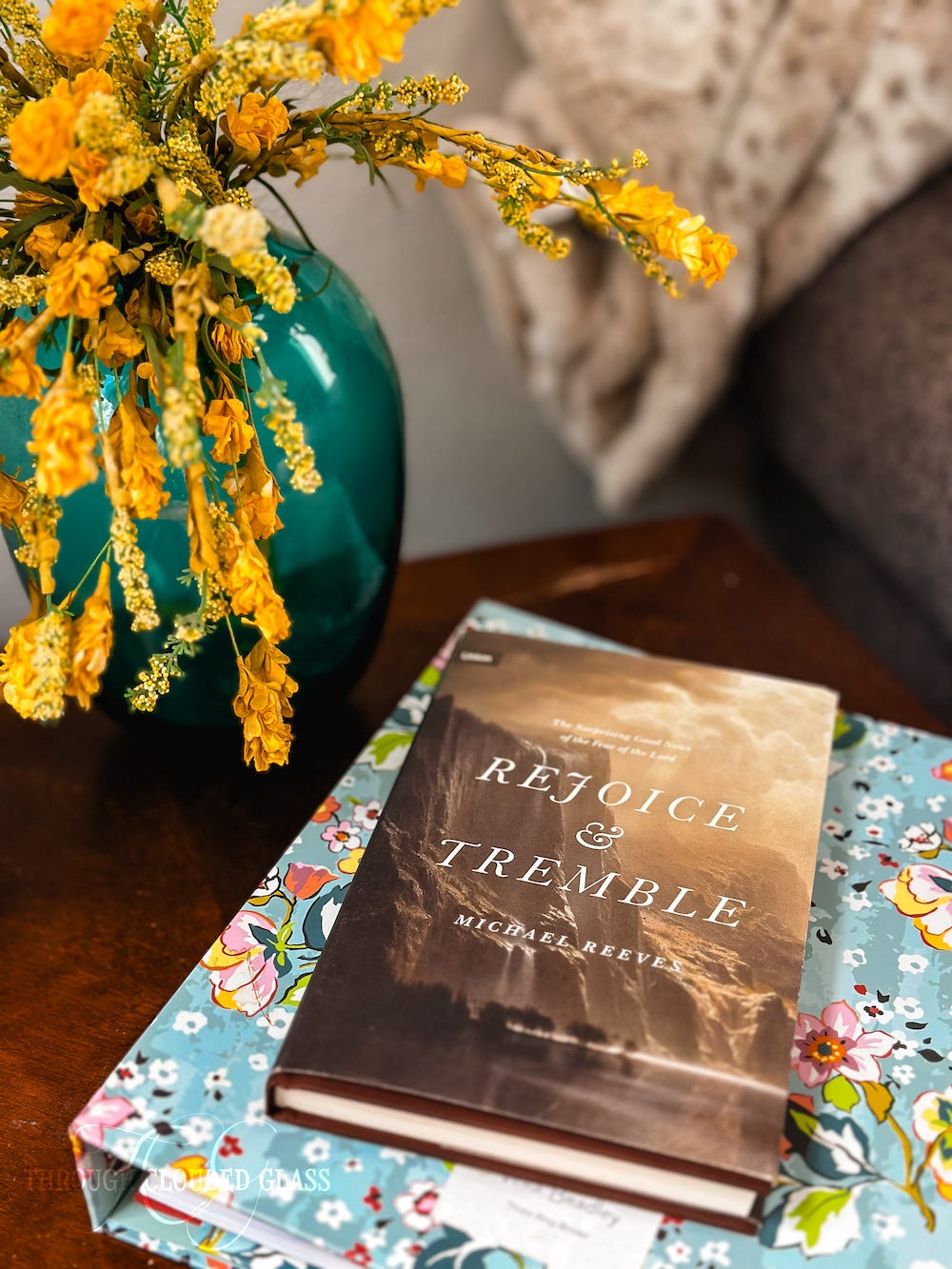
In this book, Reeves draws on the writing of some of the greatest theologians in Protestant history, such as John Calvin, Jonathan Edwards, and Charles Spurgeon, which adds a depth of understanding to his explanations of the fear of God. I appreciated Reeves including the experiences of fearing the Lord from men from church history who truly understood the fear of the Lord as something that makes us “rejoice and tremble.”
“The fear of the Lord is the only fear that imparts strength.” pg. 146
Reeves reminds us that this fear of the Lord is not just a right response to understanding who God is, but it is the fear which causes all other fears to pale in comparison, like the light of the sun making the light of a candle of no effect.
“As the fear of the Lord grows, it outgrows, eclipses, consumes, and destroys all rival fears. So the Lord could advise Isaiah: ‘Do not call conspiracy all that this people calls conspiracy, and do not fear what they fear, nor be in dread. But the Lord of hosts, Him you shall honor as holy. Let Him be your fear, and let Him be your dread.’ When the fear of the Lord becomes central and most important, other fears subside.” pg. 144
Reeves closes the book with reminding us that “the fear of the Lord will endure forever.” Our eternal state will consist of us finally fearing the Lord perfectly, and falling on our faces in loving adoration, joy, and wonder. The Holy Spirit works in us by growing our joyful fear of the Lord, and in Heaven it will finally be perfected. We will understand God rightly forever, rejoicing and trembling. The way Reeves described it made me long even more for that day!
“In other words, our eternal joy will consist precisely in this fear of God: rejoicing and marveling so entirely that, like the angels, we burn and tremble and fall on our faces in wonder.” pg.163
If you have ever struggled to understand the fear of the Lord, I highly recommend picking up Rejoice And Tremble. I firmly believe this book will deepen your understanding of this wonderful fear that we are called to, and make you love the Savior all the more for His fearful glory and majesty.
*Note: I received a copy of this book for free from the publisher in exchange for a review - this is my honest opinion.

For the past several years I have been learning more about church history than I ever have before. There is such a rich history and tradition that we as Protestants sometimes fail to tap into - and that's a shame! There is so much to learn from Christians who have come before us, so many beautiful thoughts and prayers that we can make our own and pray with brothers or sisters in Christ from ages past.
Because this has been something I have been focused on for several years, for myself and my kids, when I stumbled across Jonathan Gibson's series of liturgical books last fall, my curiosity was piqued. I bought O Come O Come Emmanual this last November and read it over the Christmas season, and it was such a lovely experience. Because of that, when I saw that an Easter addition to this series was coming this Spring, I jumped on the chance to review it!
O Scared Head Now Wounded: A Liturgy For Daily Worship From Pascha To Pentecost is a gorgeous book. The actual book is cloth-bound and looks almost like a hymnal, and it comes in a hardcover purple sleeve with gold edging. The colors chosen are perfect for Easter in my opinion, and the attention to detail in the design is so well done. This book is heirloom quality.

Not only would this volume look gorgeous on a bookshelf, but the content is just as rich. The book starts with chapters explaining the intent of the book, which is to help Christians in reflection and remembering what Christ did for us by His resurrection, as we are commanded to do in Scripture (2 Timothy 2:8). The focus of this volume is specifically remembering Jesus's death, burial, resurrection, ascension, and giving of the Holy Spirit at Pentecost.
"We forsake because we forget. And we forget because we choose to forget - deliberately, willfully, consciously. We forget our Creator - His covenant and commands, His ways and works and words; we forget our Redeemer - His promises and precepts, His redemption and righteousness." pg. 25
This book is a beautiful tool to help Christians focus their mind on Christ during the season of Easter (ie. Pascha). The book starts forty days prior to Easter (on Ash Wednesday, though this liturgy is in no way affiliated with the Roman Catholic practice). Each day there are sixteen elements to this routine (ie. "liturgy" which the dictionary defines as "a customary repertoire of ideas, phrases, or observances" ), which include:
Meditation - quotes from church history
Call To Worship - Scripture reading
Adoration - hymns or psalm singing from church history
Reading Of The Law - Scripture reading
Confession Of Sin - prayers from church history
Assurance Of Pardon - Scripture reading
Creed - repeated historic Christian creeds
Praise - Gloria patri or doxology singing
Catechism - select questions from the Heidleberg or Westminster Shorter catechisms
Prayer For Illumination - prayers from church history
Scripture Reading - a Bible reading plan
Prayer Of Reflection - prayers or praises from church history
Prayer Of Intercession - prayers from church history, along with prompt to pray for personal requests, your church, and the world
The Lord's Prayer - from Scripture
Benediction - weekly benedictions from Scripture
Postlude - Sing a doxology from Psalm 72
You'll notice how to many of the categories are actually just Scripture readings - this book is saturated in Scripture, and if you used it exclusively for your daily Bible time, you would not be lacking in reading God's word. When listed out, this seems like alot of categories, but I can say from experience (when I read the Christmas volume) that going through this routine truly only takes about 15-20 minutes each day.
“The aim of this devotional liturgy, designed for daily worship from Pascha to Pentecost, is to prepare us better for the season in which we remember the life, death, burial, resur-rection, and ascension of Jesus, as well as the outpouring of the Holy Spirit— all while we wait for his return. To be clear, the season is not about what we can do for Christ by our work or prayers or fasting; rather, it is about what he has done for us in his work and prayers and fasting — a work that began in his life, death, burial, resurrection, ascension, and the outpouring of his Holy Spirit, and which will conclude in his return in glory.” pg. 30
Each page gives so much food for thought that you could fill the entire day with reflecting on the material here. I use the books in this series for my personal quiet time during the appropriate seasons, but I think this liturgy would also work beautifully for use with a family, especially with kids that are a little older (middle school and up), though you could easily explain the concepts to younger kids as well.

It’s especially wonderful to me that this book is about focusing our hearts on Easter. Christmas gets so much attention because of all the bells and whistles that come with the season, and advent devotionals abound, but there are less books focused on preparing for Resurrection Day - even though it is just as important as Christmas, and in alot of ways is much more of a Christian holiday culturally than Christmas is.
I can't wait to dive into this book in my personal quiet time, starting on Valentine's Day (though there are allowances for missed days in the schedule, so it would be easy to catch up). If you are looking for a way to more deeply meditate on Jesus's work for us on the cross this Spring, with a Scripture-filled resource that also gives you a taste of the riches of church history, I highly recommend checking out this book!
Note: I received a copy of this book for free in exchange for a review. This is my honest opinion.

Church music has long been an area of interest for me.
I grew up in a picturesque little church complete with a white steeple and bell, on a plain surrounded by mountains, and every Sunday we sang hymns. Having that kind of foundational experience with the great hymns of the faith gave me a very strong appreciation of songs with theologically deep - not just theologically correct, but deep - lyrics. I still love hymns very much, for a multitude of reasons. One reason is that songs that have stood the test of time, not just decades but centuries, tie us to believers throughout all that history until now.
That said, I'm not one to eschew good modern music either. If a modern song is theologically correct and rich (a rarity, unfortunately), I'm apt to love it just as much as my old hymns.
Unfortunately, the challenge with any worship music, new or old, is to make a good judgement about whether this song is rightly praising God, or if it's subtly "me-centered" or praising man. It can get very tricky, and I'll admit that I'm pretty picky about the songs that make it onto my personal list of favorites.
With the challenge of finding Christian music that is sound and has the right focus, I started to wonder, why isn't Psalm-singing more common these days? The Psalms are, after all, songs. If God gave us a songbook right there in the middle of the Bible, why don't we sing them more?
I have personally never been in a church that sang Psalms, and when I realized that, it started to trouble me. There are some that think only Psalms should be sung in church - I'm not of that persuasion, but shouldn't we at least include the Psalms in the musical rotation? Why wouldn't we?
There are a many reasons why a lot of denominations might not sing the Psalms anymore, and I'm not sure I'm completely equipped to give a good summary of that right now. But the more I thought about it, the more I determined that though we might not sing Psalms in church much, that didn't mean we couldn't learn to sing them ourselves. So this year I've been working pretty hard, reading books, trying to figure out how to do just that.
I will write a separate post about how we've started to add some Psalms to our repertoire, but first I wanted to give a few reasons why Psalm-singing is something worth doing - including within your own family.

1. The Psalms are God's songbook.
As I mentioned above, there is no other songbook anywhere that can be rightly described as inspired by the Holy Spirit Himself. All Scripture is God-breathed, and that includes the Psalms. When we sing the Psalms, we are singing God's very words back to Him, and there is something very beautiful in that.
2. When we sing the Psalms, we can be sure we are singing theologically correct songs.
You don't have to analyze the Psalms before you sing them to look for errors or a wrong focus - God gave us these songs to sing from His Word. As long as the Psalm hasn't been "adapted" beyond recognition, there is alot of peace in knowing we are singing Scripture.
3. The Psalms connect us to believers in the Old and New Testaments.
Just as I love hymns in part because I know so many believers have sung those very words before me, the Psalms connect us even more with believers through the ages. The Israelites sang these very songs, Jesus likely sang Psalms with His disciples, the early church sang psalms. It's very inspiring to think we are singing the same praises to God that have been sung through so many ages.
4. I believe Scripture tells us to sing Psalms.
I recognize some people will differ with me on this, but I think Ephesians 5:19 indicates that we should keep singing the Psalms. Paul says:
"...speaking to one another in psalms, hymns, and spiritual songs, singing and making melody in your heart to the Lord..."
I know many people say that this verse is just referring to different types of music, but I really don't see why the word "psalms" wouldn't mean the psalms of Scripture.
5. Singing Psalms is an effective way to memorize Scripture.
No other book of the Bible has been put to music as much as the Psalms have, and this gives us a prime opportunity to take God's Word and hide it in our hearts! Not every Psalm song is a word-for-word adaptation, of course, but even if it's not word-for-word, a faithful adaptation will get the ideas of the Psalms embedded into your mind.
5. The Psalms are formative.
If you get an opportunity to read Scott Aniol's book Musing On God's Music, I highly recommend it. In it, he points out that the Psalms aren't just empty words - when we read and sing them, they are forming us as Christians. The Psalms are a cohesive book about what it means to live as a believer in a fallen world, until Christ comes to earth as King and reigns forever and ever.
Psalms show us how to respond when we are attacked and persecuted, when we are hopeless, when we sin, when we are needy, when we are full of joy, when we prosper. They rightly order our affections, and train us to respond in a godly way no matter what life brings to us. And they show us how to keep our eyes fixed on the Lord through every bit of it. Why would we not take advantage of this beautiful gift God has given us in the Psalms by learning to sing them from our hearts, until we see Him face-to-face?

I hope I've convinced you to at least consider learning to sing the Psalms if you never have before. I can tell you it's been a beautiful thing to start learning different Psalms with my kids through singing them together. Hearing their little voices singing the songs God gave us is so moving, and I know the words are being absorbed into their hearts while we sing. Since I've started this process, snatches of Psalms have also come to me in the form of a melody playing through my mind, and it's been an encouragement whenever I think of one of our Psalm songs. I know that learning the Psalms through song is going to be an effort that will be well worth it when I look back at how we spent out time together someday.
Another post coming soon on how to go about learning to sing Psalm songs when you are not very musically gifted, like me!
Have you ever sang the Psalms? Does your church use a Psalter?
I'm always interested to hear other people's experiences with Psalm-singing.

I had all kinds of ideas for December blog posts, but the last couple of weeks have been a flurry of craziness around here, mostly in a good way. I've barely had time to sit down, but everything we've been busy with has been fun memory-making!
Everything We've Been Up To
We kicked off December with a trip to a local "trial of lights" for my dad's birthday. My parents take the whole family every year and it's a highlight of December for all of us. There is one huge tree that they somehow manage to light up from the trunk to the top of it's branches, about 100 feet up, and we always stand under it and just stare. The kids aren't nearly as impressed with it as the adults - we know the amount of work that went into that!


My kids also participated in a unique field trip where they got to run a miniature town for a day, as well as manage their own bank accounts, checkbooks, and debit cards. Wyatt was the accountant for Town Hall, Gwendolyn was a mail carrier, and Clyde was an auto mechanic. They each were so happy with the positions they got, and they all took their jobs so seriously. Our cousins and various friends were able to go the same day we did, so that was fun for everyone too! I'm also proud to say that none of my kids overdrew their bank accounts. They are on their way to being financially responsible adults.
Another big event of the last couple weeks was a 10th birthday party for Gwendolyn. Her birthday is at the end of December, but we wanted to do a party for her while our good friends were in town from Kentucky. We invited close family and a few of her friends from church for an art themed party - it turned out really fun! I'm sure I'll get a post up about it at some point.
While our dear friends were in town we also took the opportunity to spend as much time with them as we could, and we had an outing to the railroad museum and a couple fun visits at our house. Of course the hardest part was having to say goodbye when they left the last night they were here. There are always tears when they leave, but it's one of those friendships that is strong enough to survive a little distance, and we are already looking forward to zoom visits and making plans for the next time we can see them.


Our family also fit in a visit to our local aquarium...we are not close to the ocean, so any aquarium here is going to be expensive and a rare treat. The kids got free tickets for completing the library reading challenge this summer, and Derek took a day off so we could go as a family. The kids loved it, and Georgie especially wanted to see the sharks! We topped off the day with a trip to the mall for some final Christmas shopping, and a Christmas movie night at home.


Speaking of the mall, we had to swing by there again on Sunday because I realized I needed to even out one of the kids' Christmas presents a bit. It is very difficult to shop for Christmas for five kids of all different ages - they want such different things, but I have to still keep the cost and number of the presents as similar as possible. It requires alot of planning and I often end up having to make adjustments once I get all the presents laid out on the floor.
So to the mall we went again, and I have to say, it warmed my heart to see how very busy the mall was. For the past couple years it's been quiet every time I've been to the mall, but perhaps the retail business is finally picking up again after 2020 (or maybe people are trying to avoid the finicky postal system). I'm happy to see it.
Amid all this we also had several other Christmas and birthday parties to attend, and we somehow fit some school in there. I'm tired just thinking about it now.
But it's finally the week before Christmas, we are on break from homeschooling, and it's time to get those presents wrapped and cookies baked! That's the agenda for today, and before I go to it, I'll just include one more thought that I've been mulling over this week.
A Thought On Christmas Busyness
As I've been going about our business this month, I've been listening to some Christmas sermons on the Canon+ app. I subscribed a while back for a webinar I wanted to watch, but it's been pretty worthwhile overall. I don't agree with everything they teach (I'm not a post millennialist), but I've found alot of the practical resources to be incredibly encouraging.
I was listening to a sermon called "A Theology Of Christmas Gifts" (or it might have been "Celebrating Christmas Like A Puritan", I can't remember), and Douglas Wilson made a point that it is actually NOT an unbiblical idea to work hard - even until you are rather exhausted - in order to bless others.
I think we are often, as wives and mothers, tempted to get a little bitter about the December rush and the Christmas stress. We think in order to do Christmas "right", we should not be so busy. I've certainly fallen victim to "Christmas stress" before, and often that stress is the result of procrastination or poor planning on my part. I don't think that's a good thing, and the solution to that is to plan better so I don't have a million things to do all at once December.
However, as I've been mulling it over, I agree that the problem is not the amount of work that Christmas entails. Work is not a bad thing. We don't have to be sitting around contemplating all the time in order to be blessed during the season of Christmas preparation. We are working hard to make Christmas special for our loved ones, to bless others and love them in a tangible way, and isn't that service toward others a kind of offering to the Lord? We ARE honoring Christmas in all the busyness of our Christmas work if we keep in mind that we are doing it for Him, that we are serving Christ by serving others well.

We don't always have to be still with perfect peace to celebrate and enjoy Christmas. We can keep Christmas well. by tackling our to-do list to bless others during all the hustle and bustle of celebrating the birth of our King! In it's own way, that is just as beautiful as sitting in silence and contemplating His birth, maybe even more beautiful if in the busyness we are giving of ourselves for the good of others, reflecting in an imperfect way how Christ gave Himself for us, and pointing others to the purpose of all this which is Christ Himself.
May you point your loved ones to Jesus through the cookie decorating, present wrapping, house cleaning, turkey baking, visiting, opening, singing, and celebrating this week!
Happy Christmas break, friends!
I'm sure I'll be back again this week.
I finally have some space for all of the above,
and a little blogging too.

Every year in the month of October, I dig out all my church history books, and especially books related to the Protestant Reformation. Reformation Day is today, and October is the perfect time to dive into the history of this turning point in the history of the church.
This year, one phrase that has stood out to me is the Latin post tenebrous lux - which means "after darkness, light".
I love that this become somewhat of a slogan for the Reformation. So much is contained in those words.
The Reformation dusted off the light of the gospel.
When I think post tenebrous lux the first thing I think of with all my book reading is, of course, the Reformation itself. Medieval times before the Reformation were indeed dark spiritually. Few ordinary people had access to any part of God's word, and they all had to rely on the Catholic church's presentation of the words of the Latin Vulgate translation of the Bible, which most people could not read for themselves to either confirm or deny the church's teaching.
Human beings are sinful, and without God's word being available for accountability, this led to alot of unbiblical teaching and corruption. People were taught that they never could know if they would be in Heaven after they died - to claim assurance was considered a sin. They must become righteous in themselves to a certain level in order to receive the grace of God that would usher them into Heaven - if not, they must do their time suffering in Purgatory. But of course, they could purchase indulgences to shorten their loved ones' time in Purgatory - there were cathedrals to be built, and this was the church's way of raising money.
Imagine living in a time when there was no hope of you ever being able to read the Bible for yourself, no hope of ever being sure of Heaven, because who could ever know if they had been righteous enough? What a burden to bear!

The Reformation was a perfect storm of events that God used for the recovery of the gospel, and it made the Bible available to the ordinary man. The reformers discovered from Scripture that we as sinners can never attain to any level of righteousness on our own. All our righteous deeds are as filthy rags.
But we are all like an unclean thing,
And all our righteousnesses are like [b]filthy rags;
We all fade as a leaf,
And our iniquities, like the wind,Have taken us away.Isaiah 64:6
No, it is Jesus's righteousness that wholly saves us, through faith in Him alone. When we trust in Him by faith, a faith given to us by the grace of God, the righteousness of Christ is accounted to us, and His righteousness is perfect. Because of Jesus's death to pay the price of our sin, and His perfect righteousness which He gives to us, we can be perfectly assured of Heaven when we trust in Him alone. No one else gets the glory for any piece of our salvation except God alone. And the reformers knew all this because of careful study of God's word alone, which leads to the next thing that the slogan of the Reformation reminds me of.
Scripture is a light.
Your word is a lamp to my feet
And a light to my path.Psalm 119:105
I don't think alot of modern Christians fully understand how rare and beautiful of a thing it is that they are able to hold a Bible in their lap and read it for themselves - indeed, to sometimes have a shelf full of unread Bibles, even. We take Scripture for granted today, but there was a time when there was no translation of Scripture that the masses could read. There was a time when people would go to great lengths and pay a high price, just for a few pages of the Bible. No wonder there was a period of darkness, because the only way we can come to a knowledge of the truth is through the word of God!

The Bible often refers to itself as light, because it is the very word of God, active, effective for bringing the light of the knowledge of Christ to our hearts.
Back then, even a few pages was as a blessed lamp, giving hope to those wandering in darkness. Now so many Bibles "light" our land that we have sometimes forgotten what a beautiful light it truly is.
The Reformation is what allowed us to have a shelf of unused Bibles in the first place - God allowed Luther and the other reformers to recognize the true gospel in Scripture around the same time as Gutenburg invented the printing press. A perfect development at the perfect time to allow God's word to be read by anyone who could read.
Sometimes the world is dark, sometimes so dark things seem hopeless. But God always brings us light, in His wonderful mercy and grace.
Christ is our light.
For it is the God who commanded light to shine out of darkness, who has shone in our hearts to give the light of the knowledge of the glory of God in the face of Jesus Christ.
2 Corinthians 4:6
When I read the phrase "after darkness, light", the other thing that came to mind is Christ Himself. Without the work of Jesus on our behalf, we would be lost in the darkness of our sin. Because He suffered the punishment that we ourselves deserved for our sin, having no sin Himself, He became the perfect sacrifice in our place.
He bought us peace with God with His blood.
But now in Christ Jesus you who once were far off have been brought near by the blood of Christ. For He Himself is our peace...Ephesians 2:13-14
On that glorious morning, He rose from the dead and conquered death and darkness forever! The darkness that is left in our world today is just the remnants, the last ragings of a defeated foe. Our light has come in the hope we now have in Christ.

So many are still walking in darkness, blind to the light of the knowledge of Christ. They don't know what He has done to save them. They are blind and dead in their sins, relying on lies, perhaps relying on their own supposed goodness to somehow be enough, even though it never can be. Everything we do is tainted with sin, which God cannot have in His presence. Humanity has no hope of seeing His face - except if we give up any notion of our own goodness, confess we are sinners, and cling to the Savior as our only hope.
On this day in particular, many celebrate darkness and make light of death, a morbid coping mechanism. I hope while our culture glorifies death and darkness today, we who have placed our trust in only Christ won't forget that we also are to be the light of the world.
You are the light of the world. A city that is set on a hill cannot be hidden. Nor do they light a lamp and put it under a basket, but on a lampstand, and it gives light to all who are in the house. Let your light so shine before men, that they may see your good works and glorify your Father in heaven.
Mathew 5:14-16
We are lights not because of anything we have done, but because of the light God has given us in Christ and His word which we are now called to share. We know the hope that is in Christ, because we ourselves have been brought out of the darkness of our sin and death into the marvelous light of salvation in Jesus. When that really sinks in, how can we help but want to share it? I hope today is a day for you to bask in the light of the knowledge of God in Christ Jesus, and find some way to reflect that to others. That's why we are still here!
For you were once darkness, but now you are light in the Lord. Walk as children of light.
Ephesians 5:8
Let's give others a chance to also treasure those words. After darkness, light. After blindness and darkness and sin and rebellion and death - Christ.
Soli deo gloria - all to the glory of God alone.
Happy Reformation Day, friends!
Subscribe to:
Posts (Atom)


