

I’ve been thinking lately about what kind of habits and skills I want my children to have in place before they are technical adults. When I pause a moment and realize that my oldest will be eighteen in a mere five years, that is sobering. What kind of things do I need to teach him before he launches? Five years doesn’t feel like enough.
It is tempting to focus on college prep skills - how to write a great essay, time management, how to take a test, how to read difficult books. Or maybe we should focus on life skills - how to not overdraw your bank account, how to file taxes, how to change a tire, how to be a valuable worker and hold down a job. And of course, there are character traits I want them to have - how to persevere, be reliable, be honest, be a courageous person, be an encourager, forgive others, be kind.
All these things are important, and of course we make plans to instill all those things in our children. But what are the most important things they need to learn? As I fret and worry about all the skills that my children should have, with an eye on the ticking clock, a verse niggles at the back of my mind.
“‘Martha, Martha, you are worried and troubled about many things. But one thing is needed, and Mary has chosen that good part, which will not be taken from her.’” Luke 10:41
The good part Mary chose was to sit at the feet of Jesus, to hear His words, to soak them in and treat them as the treasure they were.
This is the one thing that is needed. My kids will learn everything else at some point, but if they miss this one thing, they’ve missed it all.
The habit of being in the Word daily, verses hidden in their hearts, the skill of how to study the Bible - this is the one thing that is needed, because these are Jesus’s very words. This is how we grow in our love of Him, and if we’ve missed Him, we’ve missed everything. So at the top of my list of things I want to give my children is the skills to know Him through His word.
Daily Bible Study And Memorization
When I was 9 years old, I read a fiction book in which one of the characters casually mentioned that you can read the whole Bible in a year if you read three chapters every day and five on Sunday. It was like a lightbulb turned on. Shortly after that, I used some of my own money to buy a devotional book, and started a daily Bible routine of my own, reading three chapters a day.
I read through the Bible several times by the time I reached the teenage years, and just reading the Bible and letting it get into all the corners of my mind was hugely helpful. My mom also took us to a community Bible study, and we learned alot of basic Bible study skills there. We attended a small country church that deeply cared about encouraging the kids to memorize Bible verses, and they offered two dollars toward summer camp fees for every verse we memorized. I memorized hundreds of verses before I graduated high school.
By the time I was an adult, I had my devotional routine firmly entrenched, I knew many Bible verses, and generally could find whatever passage I was looking for. Love of the Bible is bolstered by a familiarity with the Bible, and that is a beautiful thing. Since they were little, I’ve been trying to give my own kids both those things by equipping them to develop their own daily devotional habit.
These are a few ideas for helping kids with daily Bible time and verse memorization.
-Encourage your kids to join you for your quiet time each morning. I think the most impactful way to help your kids develop the habit of being in God’s Word every day is to make it a habit for yourself. I know that I have memories of my mother sitting at the kitchen table every morning, with her coffee in hand and Bible open. Knowing she was making her own Bible time a priority was a great encouragement to me.
-Read the Bible together. Sometimes kids go through a period of struggling with reading or understanding the Bible. Don’t let learning struggles get in the way of giving your children God’s Word! I’ve been reading the Bible with my kids as part of our homeschool morning time for the last couple years, and it has been so enriching for our family. It has opened up so many spiritual conversations that we may not have had otherwise. My goal is to read every book of the Bible to them before they graduate.
-Give them external motivation if necessary. I personally am not opposed to giving kids some sort of reward for being faithful in Bible reading, for memorizing verses, or for reading the whole Bible themselves. There may be a danger of them only reading the Bible because of the reward, but I also know that God’s Word is living and powerful, and does not return void (Hebrews 4:12,Isaiah 55:11). Even if their motivations may start out as less than stellar, my hope is that the little extra push will establish a habit in them that will not be easily broken later.
-Join a Bible memory program, or come up with your own program and reward system. I loved that the church in which I grew up had a meaningful reward for Bible memory, and when we had children I knew we needed something similar. We’ve been part of an Awana program at church for years now, and it has been a great way to encourage my kids in Bible memorization. As I’m starting to have kids graduating from Awana now, I am trying to mull over ways to create my own program so they remain motivated to memorize.
-Memorize verses together. We’ve had alot of success whenever we have established a routine of learning Bible verses as a family. I usually say a phrase, and have the kids repeat it, until we are comfortable, and then we go to the next phrase. Sometimes I’ll write the verse on a board, and between repeating it the kids will take turns erasing a word, until we can say it with no help from the board. Faithfully learning more passages of Scripture together is something I’m still working on, because I can see how those passages we have done have stuck in my children’s minds.
Developing Bible Study Skills
Aside from solid Bible reading habits and memorization skills, as my kids began to reach the teen years, I want them to learn how to deeply study a book of the Bible on their own. Though I’ve done Bible studies at church and Bible study guides on my own for years, I have only learned how to deeply study a book of the Bible on my own over the last couple years. It’s been so enriching for me, and I would like to pass those skills to my kids before they grow up so they can enter adulthood with an established method of how to rightly handle God’s Word.
Instead of a list of tips, in this section I want to give a review of a book that I recently read. It is a wonderful tool for helping teens learn how to really study the Bible before they leave home.
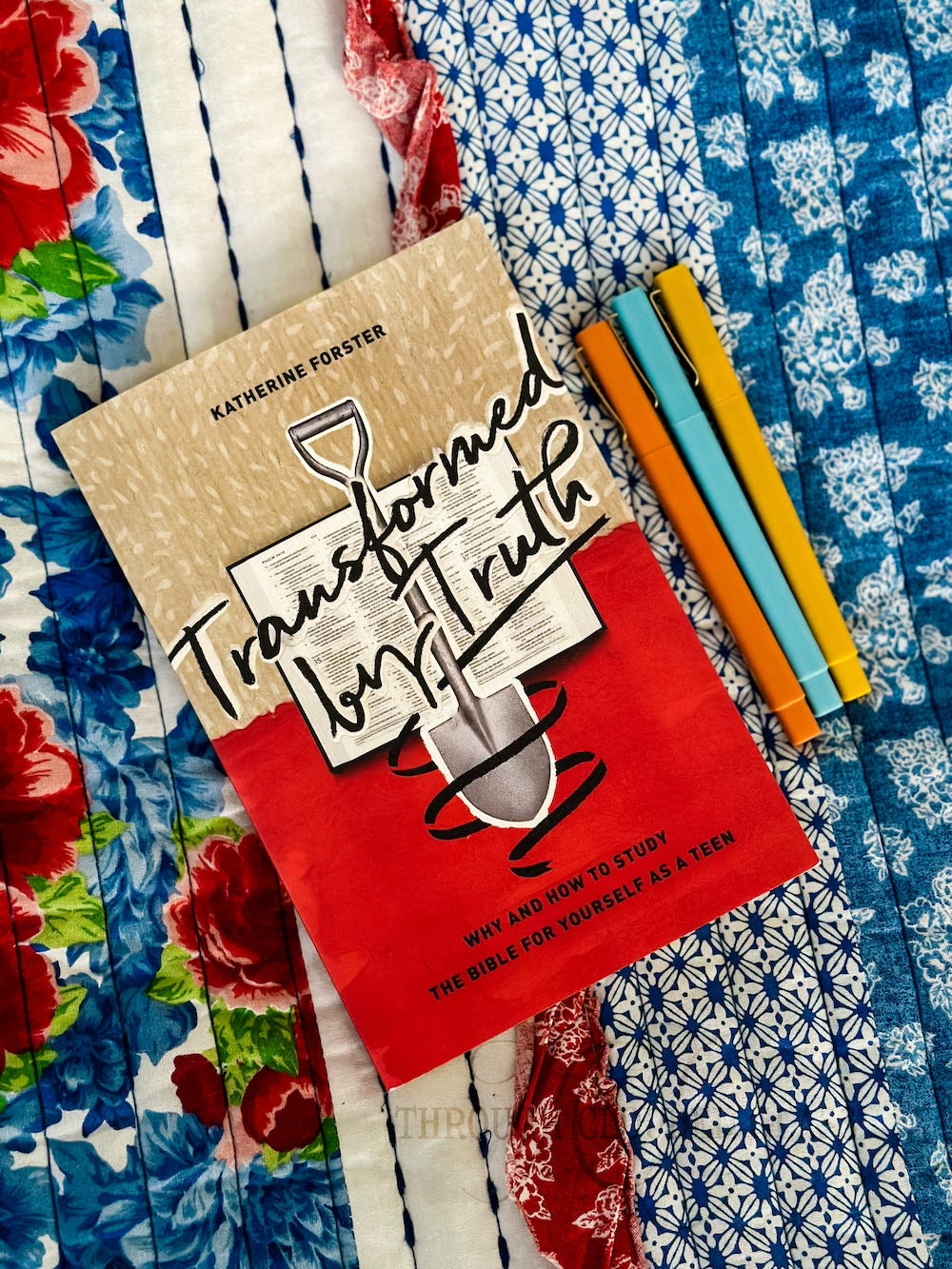
Transformed By Truth by Katherine Forster
My previous tips are mostly aimed at helping kids develop a habit of Bible study, but I think Transformed By Truth by Katherine Forster is a wonderful way to address the heart of Bible study. Forster is a National Bible Bee winner, and in the process of studying for the Bible Bee, she has gained so many wonderful insights into the Bible and how to dig deeply into God’s Word. She has written this book for teens in the hopes of spurring them on toward a deeper love of the Bible.
Forster shares her personal experience of learning to study and love the Bible. She starts with presenting the “big picture” of the Bible, and why this book should be the most important one in the world to us. Throughout the book she systematically shows us why we should study the Bible. I love what she says here:
“Bible study isn’t about gaining a bunch of knowledge. It’s not about becoming a better Christian so God will love you more (the Lord forbid we ever think that way!). It’s not about being smarter so we can feel better about ourselves. In fact if all we ever do is collect information about God without letting it touch our hearts and move us to love and wonder, we’ve completely missed it. In Bible study, we get to behold our God.” pg. 81
After diving into the why of Bible study, Forster gets into the “how” of Bible study. There is so much meat in this section of the book. She addresses developing the habit of Bible reading and studying the Bible with the local church. Then she gives a thoroughly helpful explanation of how to do your own inductive study of a book of the Bible. She teaches us the proper methods of observation, interpretation, and application, and gives us a myriad of tools to enrich our Bible study - all while offering advice on how to avoid misinterpretation by comparing Scripture with Scripture and always keeping context in mind.
“On our own, we’re liable to misinterpret the Scriptures, twist them to fit our own desires, and misuse them to build up our own self-righteousness while tearing others down. We’re handling weighty, everlasting things with fingers of dust. Why would we think our hands could hold these truths on our own? Why would we think our minds could comprehend the words of God Himself unless He graciously gives us help?” pg. 106
Forster also covers so many Bible study tools that the vast majority of people are probably not familiar with. You may have used a concordance before, but do you know how Strong’s concordance can be used to find out the specific Greek or Hebrew word that is used? Do you know how to use a lexicon to understand further shades of meaning in the original language? These are some of the deeper Bible study skills that Forster walks teens through in this book.
Throughout Transformed By Truth, Forster’s love for and high view of Scripture is embedded into every page. You can’t help but catch it by the end of the book.
This is a book I will be having my middle schoolers read as part of their homeschool this year. My oldest is nearly done reading it, and after my daughter reads it, I want to go through the “how” sections again as Forster walks us through an inductive study of 3 John. I think putting these skills into practice will be so impactful for them, giving them confidence for future independent Bible study. And it will also be so meaningful for me. It’s a privilege to get to teach these things to my children before they are grown, and Forster’s book is a wonderful guide and encouragement for learning together.
Time is ever slipping through my fingers. I’m reminded of the psalmist asking the Lord to “teach me to number my days, that I may gain a heart of wisdom” (Psalm 90:12). As my children grow older, my prayer is for the Lord to teach me to number the days of my children’s childhood, and use them well. The burden of preparing them to enter the world as Christian young people is overwhelming, but it is a weighty gift to have these years to pour into them. I want to make sure we don’t miss out on the one thing that matters most.
“The grass withers, the flower fades, but the word of our God stands forever.”
Isaiah 40:8
Note: I requested a copy of Transformed By Truth from the publisher in exchange for a free review. This is my honest opinion.


Post a Comment