


14 hours ago
Showing posts with label Homeschool Mom Thoughts. Show all posts
Showing posts with label Homeschool Mom Thoughts. Show all posts
The first time I heard the term “apologetics” was in a worldview study I did with my youth group when I was 15 years old. I had always been solid in my faith, but I remember that study being so interesting and helpful as I considered how to communicate the “reasons for the hope within you” (1 Peter 3:15). I went through another round of being interested in apologetics in my early 20s, listening to various podcasts, and reading books like The Case For Christ.
However, my relationship with apologetics quickly became a bit complicated the deeper I got into it. I became aware that there are different approaches to apologetics, and they are not all necessarily biblical. I witnessed different apologists critique methods used by others, which forced me to think through those things myself. Under the surface of all this was the sneaky suspicion that all this apologetics knowledge was not actually helping me - though it was interesting, I never needed apologetics to convince me that my faith was reasonable, and I was developing a feeling of inadequacy. I was never going to be able to remember all this information in an actual conversation about my faith.
I kind of veered away from my interest in apologetics over time, but after I became a mom and my kids grew older, the apologetics conversation became present everywhere I turned. “We need to be teaching kids apologetics!” was being shouted from every corner, and I didn’t necessarily disagree. But my uneasiness remained.

My husband and I have talked through this topic extensively, and I always feel able to communicate my thoughts so well in our private conversations, but it’s challenging to be as clear in writing or as honest in other conversations about the pitfalls I see in some aspects of apologetics. In this article, I am going to try to outline my thoughts, as a layperson who is very much not an expert on the subject. I don’t want to come across over-critical, or as if I don’t like apologetics at all! I think it can be interesting to study apologetics and very helpful for some people, and I enjoy reading about apologetics from trusted sources myself. But I believe we need to approach modern apologetics with some foundational understandings, or we could end up doing some harm.
1. Apologetics cannot be the basis for truth.
This is the point I have the most difficulty in articulating, so bear with me.
For years I have read books and heard podcasts about the “reasonableness” of Christianity, or how it’s logically consistent, or how there is so much evidence for this or that being true. And I don’t disagree with any of that. At the same time, we need to understand that someone can have a belief that is logically consistent based on the available evidence, and that belief can still be untrue. A belief that is true will be reasonable and logical and have evidence behind it, sure, but those things aren’t what make that belief true.
The real question is, what is the source of truth? Is it only based on things we see in the physical world? How do we know the physical world is actually real and not just a simulation, as some argue? Where does logic even come from, and why does it work? I hope you see the dilemma.
Logic only proves the consistency of a line of thinking, it doesn’t prove something as true. Physical evidence can be interpreted in many ways, which is why our understanding of science and history is constantly shifting as new physical evidence comes to the surface. So how can we know anything we believe about anything is actually true?
There has to be something behind it all. Truth, with a capital T, comes from somewhere else, outside of evidence and logic - it has to have a source. A good apologetics method needs to recognize that everyone is ultimately relying on their underlying source of truth, and some “sources” are as shaky as whatever they can see with their eyes. Our understanding of truth, as Christians, should not be so shallow. As Christians, we understand that we can only know something is true insofar as it aligns with the only source of Truth, which is God Himself.
2. Apologetics approaches that argue without using the Bible are actually undermining the Bible.
There is an ad going around Instagram as we speak for a “theology” curriculum that proudly proclaims that it will teach your kids how to argue for Christianity without using the Bible. I know people who have purchased it. I wonder if they understand how insidious such an approach is.
I went to a talk by Renton Rathbun recently, and he used an illustration that makes the point well, so I’m going to borrow it. Suppose you have a ruler you are using to measure something. You aren’t too sure about that ruler though, and feel like you need to confirm the measurement. So you get another ruler, and measure again with that ruler. Which ruler has now become the standard for an accurate measurement? The second ruler has become the standard by which you are now measuring the first. You can introduce as many new rulers as you want, and each new ruler becomes the standard by which you are evaluating all the others. At some point you need to pick THE standard and measure all the rulers by that one standard.
When we are “measuring” Christianity so to speak, God’s Word is the standard by which all else must be measured. If we are using something else to “confirm” the Bible, whether it be archeological evidence, logical arguments, etc., we are now setting those things as the standards and judging God’s Word by them!
This mistake is so subtle and unfortunately so common. For the Christian, God’s revelation of Himself through the special revelation of the Bible must be the standard. We cannot set the Bible aside and argue from lesser “standards” or we are undermining the very source of truth that God has given us. And as I tried to establish in the first point, without God Himself as the source of truth, which He has given to us most clearly in His Word, there is no way to know what is true at all.
3. Apologetics cannot protect your children from unbelief.
I want to reiterate here that I think it is definitely a good thing to teach our kids apologetics, especially a good apologetics method that is based on the understandings I tried to communicate above. I wouldn’t want to discourage someone away from apologetics altogether. I think apologetics can be encouraging for the Christian, and I think knowing how to communicate apologetic information to unbelievers can remove some barriers to them believing the gospel. We are told to “destroy arguments and every lofty opinion raised against the knowledge of God” (1 Cor. 10:5), and apologetics is certainly part of that.
My concern starts to arise when I see moms put too much faith in apologetics as the thing that is going to keep their child in the faith. You see this with statements like “Your kids need to study apologetics so their faith isn’t destroyed in college.” The attitude seems to be that if we give our kids enough evidence, they will have to believe, and then they will be protected from arguments from atheistic professors or friends. This is making apologetics into an idol. “Evidence” is a shaky basis for belief because someone can always bring different “evidence” that can seem very persuasive.
Like me, I am sure you have watched many a wonderful debate between Christian apologists and atheists. If presenting the evidence was all it took for someone to believe, we should see people falling on their knees and repenting right there. But clearly apologetics arguments are not enough to make someone believe.
We forget that salvation only comes from a work of the Holy Spirit on someone’s heart. Our faith does not come from an airtight argument, it comes from God Himself, by His grace. Without His conviction, we all would continue suppressing the truth in unrighteousness (Romans 1:18). God is the one that draws us (John 6:44), and the Holy Spirit convicts us of sin (John 16:8). When we are saved no one can snatch us out of Jesus’s hand (John 10:28-30). God is the one who grants us repentance, and the work He begins in us will be carried out to completion because He is faithful (Philippians 1:6).
We can give our kids all the evidence in the world, but it doesn’t guarantee their salvation and endurance in the faith - and that’s scary for us moms! But even so, it is a mistake to put our hope in apologetics. We must bring our kids before God in prayer for their salvation and spiritual growth, and tell them the gospel every chance we get. This doesn’t mean we don’t prepare our kids to face the secular arguments they will encounter throughout their lives, we should do that. But our faith needs to be in the One who will hold them fast, not in the arguments of fallible men. As we teach our kids apologetics, it should be from the perspective that God will help them persevere to the end.
4. Apologetics conversations should always lead to the gospel.
What is the purpose of apologetics, anyway? Is it mainly for Christians, or unbelievers? The word “apologetics” comes from the Greek “apologia”, which means to give a verbal defense. This is a biblical idea, since we are to demolish arguments that are raised against the knowledge of God and take every thought captive to Christ (2 Cor. 10:5). I think there is a role here in apologetics for encouraging the Christian, but what about in conversations with unbelievers?
This brings me back to the discouragement with apologetics that I developed years ago. I would listen to extremely smart apologists communicate the evidence, I read alot of books, and I often found myself rehearsing imaginary conversations in my mind. How would I communicate the evidence if I were to get into this kind of conversation? There was no way I could remember it all! It left me feeling that I could never succeed in apologetics without memorizing vast amounts of information and being ready at a moment’s notice for a debate, and that was intimidating.
In the end though, I was overcomplicating it. Apologetics should not be used to beat someone over the head with information. The end goal needs to be to communicate the gospel - and that is much less intimidating.
I’ve seen some expert apologists tear down every argument raised in debates with unbelievers, but that in itself does not bring a person to faith. We must use apologetics in conversations with unbelievers not to “own” the debate, but to bring them to the gospel message. If we forget this part, what is it all for anyway? We might look all smart and knowledgeable, but the souls of our opponents are just as lost. If we never get to the gospel, apologetics is not glorifying God, it is just glorifying ourselves.
There is an art to this, and I won’t pretend I have ever done it well in conversation myself. But it hurts me when Christian apologists are criticized (by other Christians, even) for not sticking to the debate because they tried too hard to preach the gospel in the conversation. The gospel (not apologetics) is the power of God for salvation to those who believe (Romans 1:16). Any apologetics instruction that does not also teach us how to point every conversation back to the salvation that only comes through faith in Jesus Christ - well, it’s just missing the whole point.
I’m writing this article from the perspective of a Christian mom, and I know that is also most of you who will be reading this. I hope I’ve convinced you to take care when choosing apologetics books for yourself or your kids. It takes discernment to evaluate apologetics sources for what they are holding up as the source of truth - some are obviously excluding God’s Word, but watch out for subtle undermining too. I hope I’ve also been able to remind you that our faith is in God, not in apologetic arguments, and the gospel is the key to the whole thing.
To close this article, I’ll share a few books I’ve read, in whole or in part, that approach apologetics in the way I’ve argued for here. I’m also including a couple podcasts. I wish you wisdom and discernment as you learn more about apologetics, and I pray you remember to keep Christ in the center, “in whom are hidden all the treasures of wisdom and knowledge"(Colossians 2:3).
Recommended Resources:
Expository Apologetics by Voddie Baucham - Baucham shows us how Paul himself argued apologetically in Scripture, and how to have biblical apologetics conversations ourselves.
The Ultimate Proof Of Creation by Jason Lisle - Lisle communicates problems with different approaches to apologetics, before giving us the “ultimate proof” - I haven’t finished this one yet, but I can see where he is going with it enough to recommend it.
Every Believer Confident by Mark Farnham - If you aren’t sure how to bring an apologetics conversation back to a personal level that leads to sharing the gospel, I think this is the definitive guide for how to do that.
The Renton Rathbun Show by Renton Rathbun - Rathbun actually has a PhD in Apologetics, and he has thought through the deeper issues with certain apologetics approaches. I’ve really been enjoying his conversations on this podcast.
Wretched Radio by Todd Friel - Particularly look for the “Witness Wednesday” episodes. Friel goes to college campuses and has actual conversations with students, including apologetics arguments, but in a gentle and compassionate way that always brings the student to the good news of salvation. This podcast is the main resource that has given me confidence that I could handle a witness opportunity with an unbeliever. Also see: Ray Comfort at Living Waters on Youtube.
The sun is shining bright on my face as I walk on a Saturday morning. Birds are chirping in the trees, and the ground is a bit soft after the foot of snow we got three days ago, but aside from that clue you would never guess at the swing from winter back to spring.
Birds are chirping and the breeze sways new buds on the aspen trees as I sit on a bench outside our library and eat a banana. The library opens in a few minutes, and I intend to claim the best table and set up with my laptop and homemade iced coffee.
My husband left the house with the kids this morning. He was out of town all week, and when he arrived home and I burst into tears, he recognized I was falling apart and needed some recovery time. I cried this morning when they left for a hike, feeling left out, but it only took me thirty minutes to remember that this is just what I needed. A day to recover, not just from this week, but from the whole school year. According to my husband, I get like this a little bit at the end of every homeschool year. I pour myself out all year long until there is nothing left. Time is needed to find my footing again.
Writing for my blog is my whole intention for this library visit, but I look at my drafts folder and realize I need to just write, not struggle through editing a rough draft or try to piece together a half-written post into something worthwhile. There will be time for that later, but today, we’re just going to see where this post takes us.
Spring Intention #1: Take time for recovery. Summer is coming, and I want it to be full of fun and memories, and for that I need to build my energy back up. And the only way to do that is to rest. My rules for this unexpected day to myself are:
Do not clean anything.
Spend time in the sun.
No listening to podcasts.
Enjoy the quiet.
Try to move my body a little bit.
Consume (books) and produce (a blog post, maybe a watercolor)
We had our last day of homeschool co-op yesterday, which was a field day. I was in charge of organizing the races, and I think they went quite well! We had potato (grain) sack races, three-legged races, egg-and-spoon races, water balloon toss, back-to-back races, and a blindfold race. The three groups were K-4th, 5th-8th, and high school. I think 5th-8th grade are ideal ages for this kind of thing, at least in this group of sweet, un-self-conscious homeschool kids; the younger group struggled with some of the races but had a grand time anyway, and the high schoolers were a mix of competitive and silly, and hard to organize because they were having too good a time together. But the middle schoolers took the races seriously, organized themselves promptly, and laughed whether they won or lost. I was exhausted by the end of the day, but it was still fun.
This year I was invited to join the board of our co-op, so this spring has been a flurry of interviews and planning meetings. I have become a pretty organized person over the last several years as my kids have gotten older with homeschooling, but trying to figure out what needs to happen with the co-op, and especially what we need to organize before the fall, has been a challenge. I’m already seeing glimmers of a lesson brewing: being organized is good, but I can’t control everything. Sometimes it’s good to just sit back and see how things shake out.
Spring Intention #2: Let some things go. Do what is required of you, but trust other people to do what needs to be done too. It’s best not to put everything on my own plate, which I am sometimes apt to do. This can lead to a crash-and-burn, and I know that from experience, but it’s easy to forget sometimes. For me this will look like:
Remembering that it’s okay for the house to be messy.
Saying no to some things.
Dropping some of our last lingering homeschool subjects. We’re on the home stretch.
Finishing a little homeschool planning (including a conference in June) - but then putting all thoughts of homeschooling and co-op on hold for a couple months. It’ll keep.
This spring has been rather bizarre when it comes to weather. In March we had multiple weeks of 70+ degree days, which is unheard of in the mountains. April was also quite warm, but then in the last two weeks we have had rain and snow multiple times. I am not sorry at all, because I will take some snow days over a bad wildfire season!
In April we walked around a lake in summer-like weather and got nearly eaten by mosquitos. But it was so nice to be outside and get some sunshine.


Snow in May will be just fine, because it will green up all our grass (which is already looking quite long for this early in the year). But I am so looking forward to more warm days.
Spring Intention #3: Get outside. I have been struggling with some health things this spring, and my energy levels have been non-existent, but whether I’m walking or just sitting, fresh air is invigorating. In the next few weeks before spring blooms into summer, I’d like to:
Take a walk every day.
Read on my porch.
Take the kids to a park.
Throw out some fresh grass and wildflower seeds.
Go on a picnic lunch.
Start some sort of nature journaling.
Buy some bird seed and a new feeder.
Spring is usually a high-energy time of cleaning things out and planning for the summer. I’m shushing that voice that is whispering that I’m getting behind, because it’s okay for spring to not be filled with tasks. This year spring needs to be restful, and quiet, and restorative. So that’s what I’m going to try to make it - before the pools open!
What are your plans for the rest of this spring?
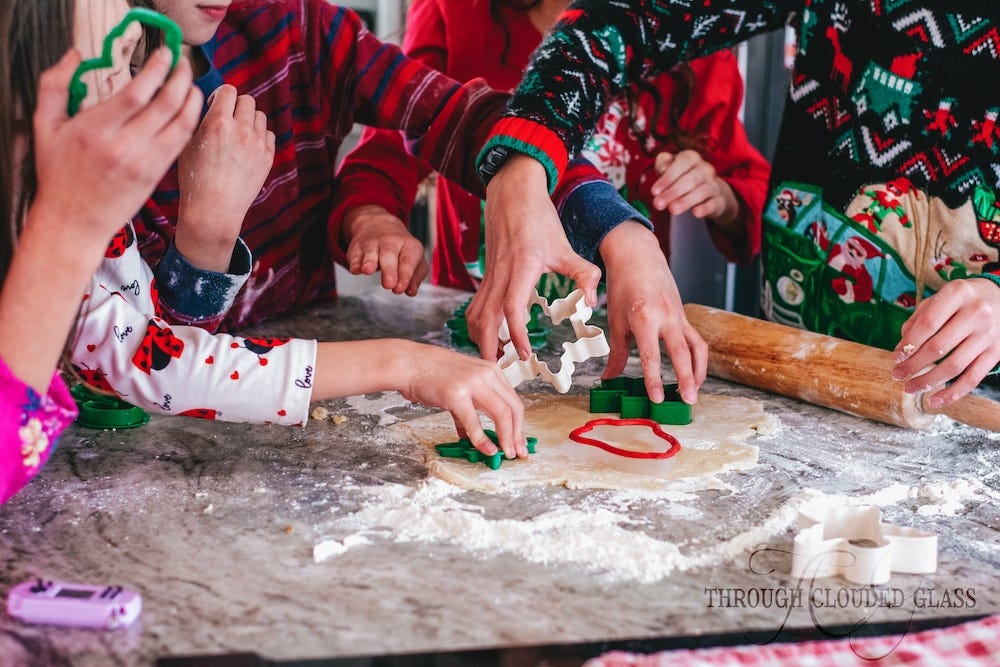
Every December I find myself wanting to set aside a weekend for in-depth Advent and Christmas school planning. Unfortunately, since it is December, I almost never have a weekend for such pursuits.
It occurred to me that alot of other homeschool moms might be in a similar place. You want to have a beautiful plan for a meaningful Advent, or Christmas School, but you have very little time to put one together. Maybe you end up purchasing a pre-made plan, only to realize it will take time (and more money) to gather all the required books and craft supplies.
I am going to share what we fall back on for homeschooling during the Christmas season. This non-plan requires no purchases (except the ones you want to buy), no required resources, and it’s open-and-go in the sense that you can do it mostly on the fly if necessary.
This is my very simple plan for adding some Christmas flair to those homeschool days between Thanksgiving and Christmas. We keep up with some of our regular subjects, but the “Christmas school” activities are a priority.
Step One: Pick a book of the Bible to read through.
Since Advent is about waiting for the coming of Jesus, and the whole Bible is His word, literally any book will do! But we want to make sure we are not neglecting spending time with Jesus by reading scripture together. Some great choices would be:
Any of the Gospels - Start at Jesus’s birth and end with His resurrection!
Psalms - Especially 100-150, which are songs of praise.
Genesis - The number of times Genesis points ahead to Jesus is astounding!
Revelation - Not for the faint of heart, but points to what we believers are waiting for now - Jesus’s return.
Step Two: Choose some Christmas carols to sing (and learn).
There are so many places you can print music for some of the good old Christmas hymns. I appreciate this free hymnal, which has a good selection. I printed up seven copies the “Incarnation” section of the hymnal, and that’s what we use for singing, but you can also just look up the lyrics for songs you want to sing as you go through the month. Sing one well-known carol each day, and choose one that’s new to you to learn each year. We have found some new favorites this way!
Songs In Our Bundle Of Papers:
Joy To The World
Hark The Herald Angels Sing
Angels We Have Heard On High
Silent Night
Away In A Manger
O Little Town Of Bethlehem
We Three Kings
Once In Royal David’s City
The First Noel
In The Bleak Midwinter
O Come All Ye Faithful
See Amid The Winter Snow
God Rest You Merry Gentlemen
It Came Upon A Midnight Clear
Good Christian Men, Rejoice (highly underrated)
Let All Mortal Flesh Keep Silence
Gentle Mary Laid Her Child
Step Three: Gather Christmas books.
This is my favorite part…if you are a homeschool mom, I know you probably have some Christmas books already in your house. Round them all up into one big stack, and grab a couple to read each day! If you really don’t have that many Christmas books to choose from, hop on your libraries website and place a few holds. Read them as they come in. I have a list of our family’s favorite Christmas books here, but the best ones are the books your library actually has, so work with what you have. If all else fails, try searching for a few titles on Youtube - there are many videos of popular picture books being read aloud.

Step Four: Make a list of Christmas crafts and goodies.
Think of goodies you were planning to make anyway, or crafts you remember from your childhood. Think of items you already have around your house you could use for crafts - construction paper for chains, oranges you could slice and dry, extra yarn you could knit into garland, flour you could make into Christmas playdough… be creative, but don’t overthink it! It doesn’t have to be complicated to be a wonderful memory. The humble paper chain is greatly underrated.
Some Christmas Craft Ideas:
paper chains
aper snowflakes
dried orange ornaments
cranberry and popcorn garland
any Christmas art tutorial on Youtube (just do a search)
handmade gift tags
Our Favorite Christmas Goodies To Make Together:
Sugar cookies
Ginger cookies
Chocolate covered pretzels
Salted caramel cookie sandwiches (using this filling recipe)
Christmas fudge
Wassail

Step Five: Make a list of activities you want to do.
You do not have to do all the activities that are listed in a perfect Advent guide - in fact, I think you shouldn’t try! Choose some things that are fun and meaningful (or even just practical) to you and your own kids, and put them on the calendar. Here are a few ideas to get you started:
Christmas Activity Ideas:
Make a day of taking the kids shopping for each other’s presents
Bake, of course (see Step Four)
Write Christmas cards (recruit everyone to help - why not?)
Listen to music from the Nutcracker (or watch the ballet on Youtube)
Listen to Handel’s Messiah
Watch an old Christmas musical
Play a game together (we like this game for a Christmas theme)
Do a Christmas scavenger hunt at the mall (search for ideas, or get these handy cards)
Read A Christmas Carol together and then watch the movie
Assign secret pals, like a secret Santa only you do nice things for each other
Plan a poetry teatime with Christmas poems, tea, and cinnamon toast (or another easy snack)
Those five steps are really all you need to do “Christmas School”! I know because this is how we have made December homeschooling special for the last five years or so.
You will notice that not all of these ideas are very school-ish or perfectly coordinated, but that’s not the point of adding Christmas activities to your homeschool day. The point is to slow down, enjoy each other’s company, make memories together, and make the excitement and wonder of Jesus birthday tangible for your kids…yes, through cookies, and playdough, and Christmas lights, and as much beauty as you can cram into the season. Point them to the reason we do all these joyful activities: because of joy for the gift of Christ Himself.

I love this quote:
“At Bethlehem, God’s Word became flesh and dwelt among us, the Consolation of Israel was born of a woman-and that moment was so staggering that even the stars had to come down and see it. And then, every year, we celebrate that moment. We take one of the most difficult theological truths— the Incarnation—and attempt to show that truth through our celebrations. The men can talk about the Incarnation, church fathers can write important treatises about it, pastors can preach about it, theologians can parse and define it ... but we women are the ones who make it taste like something. We make it smell good: How crazy is that? ‘And for my next trick, I will take Athanasius’ De Incarnatione and I will say it with cookies and wrapping paper and cinnamon and marshmallows and colored lights and tablecloths and shopping trips and frantically-last-minute-late-night-Amazon-orders and ham—and I will do it in such a way that my four-year-old will really GET it, and it will send roots deep down into his soul where it will anchor his loves and his loyalties and shape his allegiances well into his nineties.’”
-Rebekah Merle, ‘Eve In Exile’
This is what we are doing amidst all the flurry of Christmas preparations and activities. Creating the wonder of Christmas in little hearts doesn’t have to be complicated, but I hope you’ll remember that all these little special touches do matter. They make the birth of Jesus and the Gospel that much more impactful, special, and tangible to our children and families as we celebrate God’s greatest gift to mankind - our Savior.
As Charles Spurgeon says in another favorite quote:
“Feast, Christian, feast! You have a right to feast. Go to the house of feasting tomorrow! Celebrate your Savior’s birth. Do not be ashamed to be glad - you have a right to be happy.”
Let’s make this Christmas season as joy-packed as possible, even on homeschool days. Not aesthetically perfect, or impeccably organized, or flawlessly executed - just hectic, happy, warm, sparkling, messy, calm, cozy, exciting…and joyful most of all.
I have been deep in the homeschool world for the vast majority of my life, to the point where I sometimes forget how not-normal homeschooling must seem to the average mom. My mom started homeschooling me when I entered the 4th grade, and my own kids have only ever known being homeschooled. I’ve been going to homeschool conferences ever since my oldest was in kindergarten, and I’ve read more books about homeschooling than I can remember off the top of my head.
But sometimes I try to put myself in the shoes of someone who has just started to become curious about homeschooling. Maybe they have seen beautiful portrayals of a homeschool lifestyle on social media and they find it appealing. Maybe they’ve recently listened to a podcast or video with ideas that intrigued them. Maybe they know a homeschool family and would just like to understand them better.
If a friend told me they were curious about homeschooling, these are the books that I would pull off the shelves and hand to them.

For someone who just wants to know how it all works:
Answers For Homeschooling: Top 25 Questions Critics Ask by Israel Wayne
Whether you are mystified about the whole idea of homeschooling, or you want to be able to explain your interest in homeschooling to friends and family, this book will be a help to you. Wayne covers questions from critics and also addresses many practical homeschooling concerns.
For someone who wants to homeschool but is worried about socialization:
The Well-Adjusted Child by Rachel Gathercole
Gathercole addresses every concern about socialization you could think of in this book. She defines what good socialization is, then discusses issue such as family relationships, citizenship, peer-to-peer friendships, conversations between kids and adults, bullying, and being “cool”. If you need reassurance that your child won’t be missing out by being homeschooled, this is the book you should read.
If something doesn’t feel quite right about public education, but you can’t quite put your finger on it:
Weapons Of Mass Instruction by John Taylor Gatto
This book has been around for. along time, and though it’s not explicitly about homeschooling, it does paint a picture of what we could do differently (and hopefully better) than the current school system. Gatto was an award-winning public school teacher who quit teaching after thirty years and started speaking about the problems he saw with education in America. He weaves in information about the history of the public school system, and his insights are fascinating. Also see Dumbing Us Down by Gatto (shorter, also very good).
If you want to broaden your ideas about what education really is (hint: it’s not about reading textbooks and taking tests):
For The Children’s Sake: Foundations Of Education For Home And School by Susan Schaeffer Macaulay
This book was my first introduction to the idea of “living books”. As someone who has always loved to read, I was inspired to think of education in terms of connections and ideas, instead of merely remembering things until it is time to take a test. Macaulay gives an accessible introduction to the educational philosophy developed by Charlotte Mason, but whether you choose that style of homeschooling or not, there are so many sound principles in this book that are worth considering.
If you want to work on developing a truly Christian view of education:
Education: Does God Have An Opinion? by Israel Wayne
I always put a disclaimer when recommending this book to someone that the title sounds more provocative than the book actually is (at least in my opinion). Wayne gives a thorough argument for Christian education, and the chapters in the second half of the book address how to approach every educational area from a Christian worldview. These last chapters are where the book really shines! I’ve had certain children read the math chapter when they repeatedly asked “why do we have to learn math anyway” - and I can report that attitudes improved significantly.
If you want reassurance and help for a rigorous academic outcome from homeschooling:
The Well-Trained Mind by Susan Bauer
First I want to say, don’t pick this one up if you are overwhelmed or are already dealing with learning struggles. This book is not for everyone - I myself picked it up when my oldest was in kindergarten and was immediately discouraged because I couldn’t picture doing everything this book suggests. I tried it again closer to middle school, and have found it alot more helpful. However, if you are an academic person yourself, and you want a guide for providing rigorous academics for your kids, this book is it.
If you think you are ready, and you just need a push to dive in:
The Call Of The Wild And Free by Ainsley Arment
The author of this book is alot more “wild and free” than me, but even though our styles are different, I was pleasantly surprised when I picked up this book. The joy of a homeschool lifestyle bubbles off these pages, and I found myself remembering everything I love about homeschooling while reading. Arment paints a vivid picture of just how beautiful homeschooling can be, and I think it’s great for inspiring hesitant moms to jump in.

I hope if you are curious about homeschooling, you’ll find something to encourage you in this booklist - this doesn’t even scratch the surface of the amount of homeschool books out there, but it’s a good place to start!
Subtitle: How to do it, and why you may not want to

(The quintessential stack of homeschool read-alouds. These are about half of the books we went through this year.)
How can I help my kids learn to work more independently?
I’ve heard that question so many times, in conference talks, online forums, from friends, and from my own lips. Developing independent learners is something homeschool moms, especially moms of multiple kids, think about a lot.
I remember many days, collapsing into bed exhausted after being pulled in multiple directions all day, and wondering how long I could keep doing this. Helping my kids learn to work more independently became a crucial concern, like it would be the life or death of our homeschool. Now, as my oldest prepares to enter high school, I’ve seen him grow leaps and bounds in working independently, and I’ve learned a few things about helping kids be more independent. I’m sharing practical suggestions and a little straight talk.
1. Don’t push for independence too early.
When my kids were still in elementary school, in a desperate bid to find something my kids could start to do without me, I gave my older kids a workbook for language arts. When I had to be busy with another child, I would ask them to pull these workbooks out for some independent work.
At first the year seemed to go along swimmingly, but eventually I realized that while my kids were progressing to the next lesson each week, they still could not tell me the parts of speech. When we had a minor existential crisis over writing a poem, I realized that what I thought was independent work was really just busy work. In order for my kids to really learn what the workbooks were trying to teach them, I would need to sit down and go over everything with them step-by-step.
On top of that, I had wasted valuable learning time during that homeschool year when a little more effort from me up front would have set a stronger foundation. My kids were not ready to be independent, and that was normal, and I had to learn to accept it.
I think a mistake that we often make is pushing our kids to be independent in their school work too early. Some kids are naturally more independent and make homeschooling look so simple, but we need to be careful of even putting those kids into the “independent” category too quickly. Our kids may appear to be making progress, but if we never sit down and watch them do their work, we can’t really know if they are learning something, or if they are just pushing ahead in the book even when they don’t quite understand a concept. It’s our job as the homeschool mom to help them actually learn, not just get through a workbook. In the younger grades, kids need a strong foundation of understanding, through a lot of help from mom, so hopefully they can be solidly and truly independent in the older grades.
2. Start with checklists.
Once your child is at an age where they can reliably manage their own work - this usually comes in stages, so probably just one or two subjects at first - consider helping them stay on track with daily checklists.
Before I developed our checklist system, I’d often be working with one child, and another would interrupt to ask what they should do next. “I don’t know, go start on your next subject,” ended up being my vague default response - and my poor child, who still didn’t know what to do, would end up deeply invested in a lego game with a younger sibling instead of accomplishing anything.
Eventually I realized that we needed to break out of that habit, and one summer I created a document with a weekly checklist for each child, with all their subjects broken up into days. It looked something like this:
Monday:
-Math lesson -Grammar book -Copywork -Writing video (with sibling) -Read history
Tuesday:
-Math lesson -Grammar book -Copywork -Write outline for paper -Read science lesson
Wednesday:
-Math lesson -Latin -Copywork -Write first draft -Read history -Work on Awana book
Thursday:
-Math lesson -Latin -Copywork -Finish paper -Read science
Friday:
-Math lesson -Art lesson -Copywork -Type up paper -Science experiment with mom
That’s a very simplified example, but you get the idea. I have checkboxes next to each task, and once the checklist are finished, my kids know they are done for the day. I think it is motivating for them to see how much is left and to know they are making progress. It helps prevent wasted time since they always know what else they can work on by themselves (I will sometimes highlight their independent subjects a different color from the ones they need my help with). I even print these checklists for my little girls, but I am the one who manages the checklists for them, since they still need my help for nearly everything. The checklists keep me on track too.
3. Map out the year.
You can’t expect to just hand a child a homeschool curriculum and have them proceed without any help or direction from you.
A couple years ago, as my son entered middle school, I started having an “orientation day” with him toward the end of summer. We sit down with his school books and a calendar, and I show him how many lessons are in each book, how many days we have in the school year, and how many lessons he would have to finish each week to stay on track. I sometimes even write up syllabi and expectations for each homeschool subject - which is helpful, but you don’t necessarily need to go that far.
What I am trying to accomplish with our orientation days is teaching my child how to look ahead at the whole year, and provide checkmarks for them to be able to easily see that they are staying on track. It’s really teaching them how to plan by holding their hand through the process. Some kids may catch on quickly, and for most kids you’ll have to repeat this process every year until they can naturally take it on themselves. I think middle school is the best time to start this - remember, not expecting too much too early, but hopefully helping them learn more planning skills before they reach high school.
4. Remember that independence does not mean mom can be hands-off.
Another mistake I see in homeschool circles (and that I have made myself) is the tendency to become a little slack on checking up on your child once they have reached a certain level of independence. This is how you reach Christmas break and take a peek inside your child’s Latin workbook only to realize they are two months behind (ask me how I know).
Even if your child is on the correct lesson number, remember that it’s still your job as a homeschool mom to make sure the understanding of the subject is there. You should frequently ask your more independent child about what their science book is covering right now, take a peek into their workbooks often, make sure you are grading their papers and tests so you can help shore up any areas where they are struggling. Be ready to answer questions, edit their papers together so they can learn how to improve their writing, and expect to have to research the answers to confusing math questions.
If you find yourself never doing any of these things, I’d encourage you to check yourself. Are you too busy with your own projects or outside commitments to make sure your kids are progressing as they should? Are you spending too much time on your phone, and not enough time enriching your child’s homeschool experience by actually talking with them about what they’re learning?

The truth of the matter is, there really is no point when a homeschool mom can just lean back and rest on her laurels, until her kids are graduated - maybe not even then. Homeschool students are always going to need help, direction, tips, discussions, and check-ins with mom. These things aren’t a chore, but an opportunity to pour into and connect with our kids through their education. Don’t wish those tasks away - don’t push your kids too much to not need you. They do need you, you are their best and only teacher, and being there for them is the beautiful thing about homeschooling.
I’d love to hear any more tips or encouragement you have on this subject! Comment below.

Our lilac bush, which has not bloomed in three years, came to life with flowers this year. As I was choosing a photo for this post, I remembered the too-many photos I took of the lovely blooms, and it struck me that our lilac bush feels like a fitting metaphor for our homeschool season. After two years of struggling through our homeschool days, somehow as we close out this year I find myself less burned out and more excited about homeschooling again.
Often when I write these “lessons learned” posts I’ll have some general principles and advice mixed in with my points, but I don’t have any this year. The changes we made were unrelated to any specific challenges we had, but ended up shifting our homeschool dynamic in unexpected ways.
Last year I ended the year struggling hard, and the fact that this year was better is probably a mix of the changes I made and also just entering a different season with my kids. I don’t think if you are struggling you should do the same things we did this year - but if you are struggling in your homeschool, make the changes YOU need to make to feel excited about homeschooling again. Don’t be afraid to try something new, because sometimes it ends up being just what you needed.
These are the two new things we did that breathed some life back into our days.
1. We started a new Charlotte Mason curriculum for history, geography, and literature.
We have been doing Masterbooks for history since the kids were small and to be clear, we have loved it! But after going through the same books several times now, I was ready to try something else. I heard about a reformed protestant Charlotte Mason curriculum that was in its beta year, called Living Heritage, and I was intrigued. I liked a lot of the books on the lists and the layout of the curriculum, and I decided we would give it a try.
I have been familiar with Charlotte Mason’s philosophy for years, and we have incorporated some of her principles (such as narration), but this was our first attempt at a full Charlotte Mason approach for certain subjects. We followed Living Heritage Cycle 4 for history, geography, art and music, and literature (with one or two science books as well).
Living Heritage ended up being a success for all my kids. I saw them grow leaps and bounds in their abilities to recall information from the readings, and in their writing endurance (for my older kids). We had zero complaints about any of the books (except my boys making fun of the opera stories we read), and my older kids asked to continue reading “real books” for history next year too.
Since we have never done another true Charlotte Mason curriculum, I can’t compare it to the big curricula, like Ambleside Online or others. It’s my understanding that there is some crossover in the booklists. What I appreciated the most about Living Heritage was the Bible, which is treated as a full and important subject. The books under “Bible” were so rich and theologically deep. I was especially nervous that the 8th grade Bible read would be too tough for my oldest, but I was pleasantly surprised at how much he understood and retained. It taught me that I shouldn’t underestimate my kids’ abilities to understand and enjoy even hard books.
This ended up being one of my favorite years of our homeschool, but not because it was easy. We combined Living Heritage with other curricula for science and math, as well as different “spine” books for our co-op classes. It was challenging to balance everything we were doing, but I think it stretched and grew my kids, and raised my own confidence in what we can accomplish if we manage our time well. We spent a lot of time on meaningful learning, and it wasn’t a burden to me or the kids because we really enjoyed so many of the books.
I did make adjustments as we went - I dropped one classic that was proving too much of a burden, and a couple books slipped off the list merely because of time. But when I look at the stacks of books we did read, I’m left with alot of satisfaction. We will adjust the curriculum to work with our high school plan for the fall (I still can’t believe my oldest is in high school), but it wasn’t even a question that we would be doing Living Heritage in some form again. You can check out Living Heritage here.
2. We rejoined a local co-op.
After taking a four-year break from any kind of co-op group, we re-joined a local co-op this past fall. We were part of this same group when my oldest was in 3rd and 4th grade, but at that season of life with young kids, I found it too challenging to attend a weekly co-op. I was floundering and recognized I need to spend some time developing my own homeschool discipline and direction before considering a co-op again. My goal was to wait until my youngest had learned to read - and after she finished her kindergarten year, we visited the co-op again.
The timing was right for us to give co-op a try for multiple reasons. My kids were more academically independent, we had good homeschool routines established, and my youngest was reading. Over the past several years we also had several of our core homeschool friends either move away or stop homeschooling all together, and we were in a place of needing a group we could connect with locally.
It’s been new for me to balance having a vision for our homeschool days at home and keeping up with our co-op work, but it helps alot that our co-op is mom-run and flexible. All the kids’ co-op leaders are also homeschool moms with their own things going on, and we recognize that mom makes the final call on what work needs to get done and when. My kids get the most out of it when we stay on schedule with co-op, but if we have a bad week or choose to drop an assignment in favor of something else, we have freedom to make adjustments.
Socially, it’s been a lovely thing for the kids, and I don’t take it for granted. They have made friends, they have just the right balance of structure and visiting time, and the kids in this particular co-op have seemed to mesh together very well. It was what we needed this past homeschool year to keep us encouraged.

Most homeschool moms would tell you that you often have to re-learn how to homeschool every year - there are always new challenges and adjustments that need to be made! This year we took a risk on changing our homeschooling style for over half our subjects with Living Heritage, and adding a big item to our weekly schedule with co-op, but both of those changes ended up paying off, by God’s grace. I’m thankful to end this homeschool year feeling satisfied instead of burned out.
How did your homeschool year go? Did you make any major changes, or was it a year of staying the course?
Subscribe to:
Posts (Atom)


