


1 hour ago
Our family has never paid more than $200 per person per month for groceries, and we are often well under that amount. Whenever I mention that to people, I get questions about how we manage to spend so little on groceries each month. In this post I am going to give you all my tips and tricks for saving money on groceries. If you aren’t doing any of these currently and start applying them all, I feel pretty confident in saying you will save money!

However, I am very aware that each family is going to have their own unique dietary circumstances. Regional grocery prices vary, and that also plays a role. Each family also has family advantages and preferences that are going to play into the grocery budget.
For example, our family has a deep trunk-style freezer and an ancient extra fridge in the garage that allow us to buy in bulk, and you might not have that (though I feel strongly that deep freezers are a good investment). Our family has five kids but only one of them is a teenager so far. We might tick up our grocery budget as more of our kids reach the bottomless-pit stage. Our family also buys very little red meat because we hunt for our meat, and that’s cheaper. If I had to buy red meat, I’d tick up our total grocery budget by another $100 a month or so.
Still, I do very much believe that if you apply these strategies faithfully, you will save a noticeable amount of money, regardless of what other restrictions you might be working with.
Let’s Make An Agreement…
Before we start, I just want us to all understand that saving money on groceries is all about choices and trade-offs.
There are some challenges we all face in grocery shopping that are outside our control, but there is a lot that we can control. As you read, you will be evaluating your own values and deciding where you are willing to spend extra money and where you want to try to save. If you decide to spend where I would save, it’s not that one of us is right and one is wrong. These are just the choices we are making for ourselves and our families, and it’s okay if they are different.
For example, our family chooses to not buy organic. If it’s important to you to buy everything organic, you are going to spend more money than me. That’s just the way it is. Each of us are making choices about how we choose to spend our money, and neither one is inherently better than the other. If we are both comfortable with the trade-offs we are making, we can just set the moralizing aside and focus on the money-saving strategies! This is a no-judgement zone from me, and I would like it to remain a no-judgement zone in the comments as well. Agreed?
Ways To Save Money On Groceries
I’m going to cover basic strategies in this section - some of them so basic the average reader may roll their eyes, but I want to cover everything. Some of these points will be expanded into additional articles, but alot of them you could apply right away. Find a couple that you aren’t already doing and try to implement them, remembering that it takes a while to build or change a habit.
1. Buy Generic Brands
It is truly amazing the price difference between brand-name and generic brands, and this is across the board. I’ve compiled the price of basic old-fashioned oats for you as an example:

Quaker Old-Fashioned Oats, 18 oz. - $3.69 at King Soopers
Kroger Old-Fashioned Oats, 18 oz. - $2.79 at King Soopers
That’s almost a dollar you could save on just one item at King Soopers by buying generic, and that’s not even taking into account current coupons which could reduce the generic brand cost further. If you can save an average of a dollar per item buy buying generic, that could add up to a significant amount of savings.
And I’ll tell you a little secret - the generic brand is almost always the exact same thing as brand name. Sometimes the generic brands are even packaged in the same factories as brand-name items!
There are occasional items where you may find that the brand name is cheaper, and if so, go for it.
There may be items where the generic and brand name products are noticeably different, and you may sometimes prefer the brand name product over the generic version. I would encourage you to see if you can change your tastes to accept the generic version. Give the generic a few months and see if you still care about the difference. If you really decide that the brand name is worth the extra cost to you for certain items, go with peace and buy that brand name. At least you have weighed the options and are making conscious decision instead of letting brand names be the default.
How I Do It: I almost never buy the brand name version of anything, unless there is no generic version, or unless I notice the brand name is on sale and happens to be cheaper. My Exceptions: Oreos, Malt-O-Meal Mini Spooners (semi-generic), and laundry detergent.
2. Shop At Cheaper Grocery Stores
Not all grocery stores are created equal, and if you want to save money on groceries, you need to put aside your prejudices and choose your grocery store based on average prices.
Sometimes the price at a less expensive grocery store may be better than even a sale price elsewhere. Let’s look at our oatmeal example from the last section, shall we? Here I’ll compare generic prices at three different stores:

Walmart Old-Fashioned Oats, 18 oz. - $2.66
King Soopers Old-Fashioned Oats, 18 oz. - $2.79
Target Old-Fashioned Oats, 18 oz. - $2.89
Safeway Old-Fashioned Oats, 18 oz. - $3.49
You’ll notice that Walmart is at least 13 cents cheaper than the next option, a whole 83 cents cheaper than if you bought the same item at Safeway!
You may think these differences are petty, but I assure you, across the fifty different items you might buy in one grocery trip, a few cents here and there does add up to a decent amount of savings. Let’s compare eggs, for another example:

King Soopers Eggs - $2.79/dozen
Walmart Eggs - $1.97/dozen
Now, depending on where you live, you may hav more limited grocery store options, but I would encourage you to expand your travel for groceries if it would make a difference. You don’t have to shop at the grocery store closest to you. You can combine trips to make driving for groceries more economical.
How I Do It: I live in a rural community, and technically my closest grocery store is Safeway. But I don’t shop there. I pick up groceries another 25 minutes down the road at Walmart whenever I happen to be headed to town anyway. I buy almost everything at Walmart and Sam’s Club, which I find to be the cheapest grocery stores within an hour of me. There is a King Soopers and Dollar General a little closer if I need to make a quick stop for 1 ingredient, but I would never do a full shopping trip at those stores.
As an aside, I’ve had many people comment to me how they can’t stand the environment of Walmart. They want a nicergrocery shopping experience. If that’s your choice, that’s fine; remember, everything here is about trade-offs. If you want to pay more for a better experience, that’s your choice, just be aware there are cheaper options out there.
3. Cost Per Ounce Matters
Remember, saving money on groceries often comes down to cents, which adds up to dollars. The reason we buy generic is because of the savings of cents per ounce. But we can also save per ounce by buying in bulk.
Let’s compare oatmeal again (we will use King Soopers to make the point here):

Kroger Old-Fashioned Oats, 18 oz - $2.79 (15 cents/oz.)
Kroger Old-Fashioned Oats, 42 oz. - $4.49 (11 cents/oz.)
Quaker’s Old-Fashioned Oats, 160 oz. - $7.98 (5 cents/oz.)
As you can see, it is much less expensive to buy even the name-brand oats if I buy it in bulk! But even if I don’t buy in bulk, I save almost a third of the cost if I buy the larger size at King Soopers.
If it’s an item that you know you eat alot of, or if it’s a shelf-stable item, see how many cents per ounce you can save by buying a larger size. Think in percentages instead of cents if it helps you quantify the savings. If I buy oatmeal at Sam’s, I am getting 66% off the regular, non-bulk price at King Soopers. If you do this for multiple items, it actually adds up to alot of savings by the end of the month!
How I Do It: Unless I am a couple days until pay day and trying to keep the actual dollar amount low, I always check the price-per-ounce and buy according to that. I may spend more for one grocery trip, but I will save in the long term.
That leads me to my next point…
4. Buy In Bulk (When It Makes Sense)
I just showed you how much you can save by buying in bulk with oatmeal. Let’s try comparing a few more items.

505 Green Chili - $3.92 each (at Walmart)
505 Green Chili - $3.33 each (3-pack at Sam’s)

Peanut Butter - 12.1 cents/oz. (at Walmart)
Peanut Butter - 10 cents/oz. (at Sam’s)

Frozen Chicken Breasts - $2.98/lb. (at Walmart)
Frozen Chick Breasts - $2.70/lb. (at Sam’s)

Hummus - 27.2 cents/oz. (at Walmart)
Hummus - 14 cents/oz. (at Sam’s)
Some of these differences might not seem like much, only a few dollars here and there. But remember, if we do this for as many items as we reasonably can, the savings do add up at the end of the month.
Now, there are occasions when buying in bulk may not be less expensive, so back to our earlier point, always check price per ounce!
Some other times it may not make sense to buy in bulk are when you know you will only use a small amount of an ingredient, when you are buying things that will go bad quickly, when you are working with limited fridge space, or when there is a very negligible difference in the bulk price (less than a cent per ounce).
How I Do It: I check to see if there is a bulk option whenever it makes sense, and it’s almost always at least a little cheaper - and sometimes, as in the case of the oatmeal, it’s a significant percentage off. I pay for the Sam’s Club premium membership, which gives you cash back for every purchase you make, which you can then apply toward paying the membership fees whenever they come due - so I only end up paying $40-60 dollars each year ($5 or less per month). The savings from buying in bulk do outweigh that small fee in the end.
5. Think In Terms Of Price Per Meal
When you are planning out meals, I recommend thinking of how much a particular meal is going to cost per person.
For instance, I can feed everyone in my family spaghetti and meatballs for about a dollar per person. That’s a great, cheap meal, and we eat it a few times per month! On the other hand, I’ve calculated all the ingredients for something like lasagna, and it comes out to about $4.20 per person, four times as much. If we ate meals at that price every time I cooked dinner, we’d be spending much more on groceries each month. I save those more expensive meals for special days, or limit them to once a week.
Another thing you can do is think of ingredient substitutes or similar meals you could do for less. For example, spaghetti pie is a meal that tastes very similar to lasagna, and it uses similar ingredients - but because it uses cheaper meat and less cheese, it only costs about $1.70 per person.
How I Do It: I aim for the majority of our dinners to fall between $1-2 per person. Lunches and breakfasts typically cost less than that because of buying in bulk.
6. Try To Limit Pre-Made Items
In general, it’s going to be cheaper to purchase ingredients and make your own items than to buy pre-made foods. This is especially true for pre-made/frozen meals and baked goods.
For example, I can make a loaf of sourdough bread for literally a few dimes worth of flour and salt (as opposed to buying a loaf for $3-5)! I could make up to two dozen cookies for around $3 worth of ingredients. Even the one frozen meal I do buy often - frozen pizza - I probably could make for less from scratch than if I bought it pre-made.
I’m not saying there is no place for pre-made meals, because there definitely is. It would take alot of time to make pizza from scratch, and we usually eat pizza as a last-minute decision when we have a movie night, so I’m willing to pay for convenience sometimes. But if I paid for convenience all the time, that could really add up. We try to make things ourselves as much as possible. It usually tastes better than store-bought, and it saves money.
How I Do It: I stock my pantry with ingredients, instead of fully made items.
7. Shop Online And Do Grocery Pickup
We truly live in an interesting time, and one of the perks of living in 2025 is that we have the option to have someone else do the shopping legwork for us. I can’t tell you how much time this saves!
The money-saving ramifications might not be immediately obvious, but it does end up saving money in multiple ways as well. Here are the benefits:
-I can schedule pickups around times I am already going to be near the grocery store, which saves me gas money.
-I can check my pantry to see what I already have before checking out online - so if I already have it, I don’t accidentally re-buy it.
-I can check multiple grocery stores for each item to make sure I’m getting the best price - for instance, I was about to check out with my 5 dozen eggs at Sam’s, but I checked Walmart and saw they have 5 dozen eggs for a dollar less. That’s a dollar saved!
-I have time to sit and consider my grocery total before checking out, and I can contemplate what items I could eliminate or swap out to stay within my budget.
The only drawback in shopping this way is that it provides less opportunity to model smart shopping habits for my kids, which is something they would get more if I took them with me to the store. I am thinking of remedying this by picking one kid per month to sit next to me at the computer and walk through my process.
How I Do It: I mostly shop at Walmart and Sam’s. At the beginning of each month I take my time crafting a grocery order and schedule it for pickup when I will already be going to town. Walmart has free grocery pickups after a certain dollar limit, and Sam’s has free pickups if you have the premium membership (which is more cost-effective because of the money-back deal I mentioned above).
8. Shop Only Once Per Month
This is a strategy I use that I know saves me a decent amount of money each month.
The reasons why may not apply to everyone, but what I find is that whenever I make a trip to the grocery store (or place a grocery order), I always end up spending more than I originally intended. I might be hungry when I’m ordering and add a few more treats than I planned. Maybe I’ll think of a certain (more expensive) shampoo I wanted to try, and I end up adding it. I might think of something that’s running low; maybe I could wait to buy it until next month, but because I’m shopping and thinking about it right now, I go ahead and buy it.
These incidental or impulse purchases can really run my total up, and once I’ve thought of buying something it can sometimes be hard to talk myself out of buying it. And this happens every time I go to the grocery store. By limiting my trips to the grocery store each month, I limit my opportunities for impulse purchases, and thus save money.
How I Do It: I always get questions about this when I mention it, so I will be devoting a whole other post to it soon. Put your questions in the comments and I will make sure to cover them when I write that article.
Most of the previous tips are things to think about before shopping…here are a couple to think about once you have the food home.
9. Reduce Waste And Eat Leftovers
You can plan to make a little extra dinner in order to have leftovers for lunch the next day, and that is going to be less expensive than making a whole other meal for lunch. Keep an eye on the food you already have in your fridge and make it a goal to not throw anything out. If you make a double meal, you can get two dinners out of it - and once again, for some meals that’s more cost effective than buying and making a smaller amount.
For instance, with my recipe and how much my family typically eats, making enough chili for two full meals (instead of one and half) is a difference of one more extra-large can of chili beans - which is only about $2.98 at Walmart. So we can get an extra meal for less than a dollar more per person, just by planning to make extra.
How I Do It: I plan to eat leftovers either for dinner or lunch within one week; after that it might not be safe anymore. For some dinners I make extra and count on having meals of leftovers, so some meal ingredient costs will count for two meals for the whole family, further reducing the price. The less you waste, the more money you can save.
10. Be Frugal With The Snacks
Snacks between meals can add up to quite alot of extra costs, so I recommend being very aware of what kind of snacks you are buying and how expensive they are. If you find your family snacks multiple times throughout the day, you can also work on changing your snacking habits, and that will save money.
Think about the kinds of snacks you are buying, and whether you could get more bang for your buck by buying items a different way. We don’t eat alot of chips (because they are expensive!), but when I do buy chips, I buy a box of individually-packaged chips from Sam’s club. This might seem contrary to some other things I’ve said, but here is why it works: not only am I getting a better price in bulk (56.9 cents/oz. for a bag at Walmart, as opposed to 41.3 cents/oz. at Sam’s), but having pre-portioned bags will stretch the chips further and prevent excess snacking, which will ultimately save money.

How I Do It: I think hard about how many snacks I can get out of each snack-food purchase, and how much I’m paying per snack. I have to with five kids! I don’t encourage alot of snacking in between meals, and I don’t snack a ton myself. My kids might have one snack mid-morning and one mid-afternoon, and I buy things that are cost-effective for us. Snacks that I have found to be a good value are mini carrots with hummus, pretzels, animal crackers, veggie straws, trail mix, and cheese sticks. I buy all of those in bulk. When we want something sweet, I also make our own treats (brownies, apple pies, cookies, fudge) instead of buying pre-made treats, which is much more cost-effective.
As I was preparing to write this post, I asked my husband if he would let me take over his fraction of the grocery budget for an experiment. He likes particular, high-protein food items, and he was doing his own shopping so he could pick out the exact items he wanted. He is a pretty smart shopper, but he doesn’t go to the extra label-scrutinizing lengths that I do.
He humored me though and gave me his usual shopping list. This month I bought all of the things on his list, using the strategies that I shared in this post, and hauled all the items home. He looked at the two boxes of food and said it was probably more than he would eat in one month - and I had bought it all for half the cost that he usually spends! So I know these strategies do work - it takes a little extra effort and brain power, but for our family it’s worth it.
I know this is alot of information. Some of you already do some of these things. Pick one or two that you aren’t doing and see if you can implement them!
If you have not been shopping this way at all, trying to apply all this at once might be overwhelming. Look through my points and choose just one or two things to practice this next month. Once those couple things become a habit, you can add a couple more in.
Another post will be coming soon with tips on how to shop once a month.
If you have any specific questions, put them in the comments.
If you have any additional money-saving tips to share, I would love to hear those as well!
I had a request last week for an article sharing the homeschool curriculum that we are using this year.
Somewhere along the way, I stopped sharing our curriculum online. When my kids were younger I loved reading about all kinds of curricula, and subsequently sharing my own choices. It was exciting to see what was out there and get ideas!
However, as the years went on, a couple things happened. First, I settled into the day-to-day of homeschooling, and there wasn’t as much to be said about curriculum from year to year. But also, I started to realize how subjective choosing curriculum really is. Just because this curriculum works for my child, doesn’t mean a different one won’t serve your child just as well. Just because I happen to align with one curriculum, doesn’t mean it’s going to be one that anyone I know likes.
I’m not even always sure I love all my own curriculum choices absolutely. There actually is no perfect curriculum out there. I’ve been around the block enough times now to know that a different curriculum does not solve every problem, and almost any decent curriculum will do the trick if it’s diligently applied.
Even though I have mostly figured out what works for us, many people are still in the getting-ideas-and-reading-reviews stage, and so this post is for them.
Just a reminder, I have five kids, spanning from 2nd grade to a freshman in high school. We are eclectic homeschoolers in our family, meaning we make use of varied curricula and resources for different subjects. I’m drawn to classical and Charlotte Mason influences, and I am familiar with both educational philosophies without being a purist of either. We don’t read Plutarch and don’t intend to, and we like a workbook now and then.
Math
What We Use Right Now: Rightstart, Apologia, Denison
All of my kids have been taught their initial math concepts with the Rightstart Math curriculum. I like Rightstart because of the emphasis on mental math, understanding why certain math tricks and formulas work, and the abundant exposure to geometry from early ages. The way Rightstart teaches math has always matched up really well with how I think about math myself, so it’s been a good fit for the elementary years.
However, late elementary is always a period of trial with this particular curriculum - some of my kids have continued on and are doing well with it, and with other kids it became really apparent that we needed to try something else. Rightstart only goes through 8th grade, so I have always known we also needed to find something else for high school. This year half my kids are continuing on with Rightstart, and the other half are trying something else.
Apologia’s Exploring Creation With Mathematics is new to us this year and its lessons are much shorter than Rightstart. But it has been covering all the grade-appropriate basics and has been a good transition to becoming more proficient at procedural math.
Denison is our choice for Algebra this year, and it has been a dream so far. While the upper levels of Rightstart had been taking up to 2 hours per lesson (perhaps they were meant to be split into two sessions), Denison has hit the sweet spot of a reasonable amount of time and the right amount of challenge. This curriculum is written specifically for homeschoolers - my husband and I sat down to research different Algebra curricula, and as soon as we watched the sample lesson and saw how well the instructor understood homeschooling, we were sold.
History & Geography
What We Use Right Now: Living Heritage, Biblioplan, Story Of The World
Last year I made the switch to a more “true” Charlotte Mason curriculum, called Living Heritage, and it has overall been a really enriching choice for our family. Living Heritage is a guide more than a curriculum - all the chapter books and other resources must be purchased separately (similar to Ambleside Online). It follows a four year history cycle, and tailors all the resources around the history “streams”.

We mostly use Living Heritage for the history, literature, and art and music book choices, with an occasional science read thrown in. We don’t follow their recommendations for math or science, and we are about half-in with grammar. I retain the right to nix any book that I just don’t find worthwhile for whatever reason. However, even using the guide only partially, it has been worth the money to me. We have read so many wonderful books together, and my kids’ “independent history reads” from the booklist are one of their favorite parts of the day. It has really brought different historical periods to life, especially ones that would otherwise feel a little dry.
We are also part of a somewhat classical co-op, and for that we are going through Biblioplan for middle and high school, and Story Of The World for younger students. Though I didn’t choose the curriculum, I am actually teaching Biblioplan for middle and high school at our co-op, and I’m still becoming familiar with it.
I will say this for it - Biblioplan is very thorough. If you try to poke around on the website you will see how overwhelming it can feel. We are still getting our feet under us, but I think it’s actually nice for my kids to have a history “spine” textbook, and then to have the Living Heritage choices at home to add the color. It ends up being alot of history work each week, especially for high school, but we are making it work.
I feel ambivalent about Story Of The World - my younger kids enjoy it at co-op, but all we do at home is read the chapter to keep up with it.
Science
What We Are Using Now: Berean Builders, Apologia, a little bit of Living Heritage
We have used Apologia Young Explorers series for my elementary kids since the beginning, and they quite enjoy it. My 2nd, 4th, and 6th grader are doing Land Animals Of The Sixth Day (1st edition) with co-op right now, and because that is the science we would have chosen with or without co-op, it’s been working out really well.
My 7th grader is using an older version of Exploring Creation With Earth Science from Apologia. This is a textbook written by Jay Wile, and I much prefer his middle and high school science texts to the more recent editions from Apologia. I could go into more detail in the comments if anyone wants more information.
Because I don’t like the current Apologia editions as well, I’m okay with my 7th grader doing an older textbook for middle school. I already had the curriculum, and even though scientific understanding is always changing, middle-school level earth science is unlikely to have changed too terribly much in only 20 years since the text was first published.
My high schooler is doing Berean Builders, Discovering Design With Biology, at home. Berean Builders is a newer curriculum company from Jay Wile, the same author of the older Apologia texts that I like so much. One of the things I love about Wile’s approach to teaching science is how he guides the students in keeping a scientific notebook in which to record experiments according the scientific process. You don’t buy a separate “student journal” that hand-holds your kids through recording observations, or worse, just gives them busywork. Instead kids learn how to keep a notebook like a real scientist would. I was once a homeschool student learning from one of Wile’s courses, and that skill of writing up experiments served me particularly well when I got to college.
My kids are also reading an occasional science living book to go along with their studies. For instance, my high schooler is reading All Creatures Great And Small to go along with biology.
Language Arts
What We Are Using Now: Living Heritage, Fireworks Press, Spelling Power, Generations, All About Reading, IEW, copywork, and a bunch of other random books
We now come to the behemoth category of homeschool curricula, “language arts” - which is somehow supposed to cover phonics, handwriting, reading comprehension, spelling, grammar, vocabulary, and maybe even literature too. Is it any wonder I have such a long, hodgepodge resource list?
My 2nd and 4th grader are making their way through All About Reading, which is the best phonics-based reading curriculum on the market, in my opinion. Well worth the slightly high price tag, especially if you have multiple budding readers who will use it. My 2nd grader also has the English 2 workbook from Generations, which has been nice for extra handwriting, spelling, and light grammar. Both my little girls are also doing their respective books in Handwriting Without Tears.
My 4th grader is going through Royal Fireworks Press’s Grammar Town with my 6th and 7th grader. It is a discussion-based approach to teaching grammar and sentence analysis. This is our first year trying this, so the jury is still out on how we feel about it - in previous years we have used Rod & Staff grammar, and that has given us a good foundation from which to try something different.
All my younger kids do weekly spelling tests using Spelling Power, and I am reminded that sometimes the most boring resource is the one that gets the job done. There are no fancy pages or cards or tiles to keep track of here - just literally a book filled with lists of words. It is the only spelling curriculum that has made a lick of difference.
My kids are reading various literature books at their individual levels from the Living Heritage curriculum lists. My youngest two narrate their books orally, and my oldest three write narrations on the books they read - one each day for my high schooler, 2 or 3 per week for my 6th and 7th grader.
We are also going through IEW’s theme-based writing books with co-op, so my big kids are writing a short paper (1-3 paragraphs) for that each week.
Bible
What We Are Using Now: Answers Bible Curriculum, the Tune My Heart catechism, devotional and theological books, and the actual Bible
We have hopped around to different Bible curricula over the years. We really like Answer Bible Curriculum, and it’s something that can be done with the whole family. We have unfortunately used it a little sporadically because we are typically using alot of other resources at the same time. But every time we pick it up the lessons are so rich.
My kids are reading various devotional and theological books as part of the Living Heritage curriculum, and I have been so pleased with the choices so far. We have covered alot of really deep theological topics that I’m not sure how we would have discussed otherwise. We also work on a catechism question (I’m partial to the Westminster Shorter Catechism, but we are trying the Tune My Heart catechism this year) and we read through the Apostle’s and Nicene creeds during our morning time, all of which are full of biblical truth.
However, my best recommendation for studying the Bible in homeschooling is to just pick up the Bible and read it together. You actually don’t need anything fancy to study the Bible with your kids. Just read it, and discuss it, and pray over it together. You will be surprised how enriching that is. This is my favorite discussion guide if you need a little guidance.
Extras
What We Are Using Now: Living Heritage recommendations, Art classes
By extras, I mean things like art, music, Shakespeare, and poetry. There are so many good books and resources for doing picture study and composer study. There are tons of online art tutorials, and books filled with collections of poetry for kids. For Shakespeare we just listen to the play with a copy of the text on the table and a highlighter in hand.
This year we are using alot of guidance from the Living Heritage resource recommendations for these areas of study, and my kids also take an excellent art class at co-op. In the past we have made good use of the Simply Charlotte Mason website, the library, and Youtube. Here are a few favorite resources:
How To Teach Your Children Shakespeare
Simply Charlotte Mason Picture Study
Simply Charlotte Mason Composer Study
Ark Angel Shakespeare Productions
Humility and Doxology Poetry Lists
Homeschool Compass Poetry Lists

As you can see, it’s never a simple answer when someone asks me what curriculum we use! I almost envy those people who can simply reply “Abeka” or something. However, piecing our curriculum together over the years has been a joy to me, and has allowed me to customize our curriculum - not only for my particular kids, but also according to our own family values and educational priorities.
That’s the wonderful thing about homeschooling isn’t it?
I’m happy to answer any questions about why I do or don’t like a curriculum, or give more thorough reviews of individual curricula in the comments!

My friend sat across from me in the coffee shop, drinking something hot from a big glass mug. I took a nibble from my pumpkin bread and choked back a few tears as I prepared to confess something.
It had been a very rough start to the year, and I knew I was in desperate need of prayers for strength. I was discouraged, at a loss for how to help in a difficult situation. I knew I need the Lord’s wisdom and prayer support through this hard time. Aside from my family, I had a handful of friends who I absolutely knew would remember me in their prayers if I asked them.
As I sat across from one such friend, I voiced the thing that had been burdening me ever since this hard season started. I had a feeling about the sort of people I could count on to pray for me, and in contrast, the people that didn’t give me the same confidence. That’s when an uncomfortable thought occurred to me.
Was I the kind of person that my own friends could count on to pray for them?
I had to admit to myself that I probably was not that kind of person for those dear to me. I was often sympathetic in the moment, might shoot up a quick prayer, but then would forget.
The healthy kind of shame came over me. I don’t want to be that way anymore. I want to be the kind that can be counted on to pray and not forget.
Thus began my 2025 mission of figuring out a prayer routine and system that will help me become a true praying woman. Not just praying in the moment, but someone who will hold my loved ones up in prayer over and over again, until their needs are answered one way or another. Someone who will “pray without ceasing” (1 Thess. 5:17).
I’ve been slowly working through books on prayer, and writing myself reminders to pray in my phone. I been writing out prayer requests, and trying to become fluent at praying Scripture, and falling in and out of the habit of morning prayer too many times. Striving to figure this whole thing out, alternating between success and failure.
I think learning to become a woman of prayer is probably always like that, trying, and failing, and trying again. But hopefully becoming more and more faithful along the way.
In light of my ongoing desire to become better at prayer, I wanted to share one of the prayer resources I’ve picked up recently. I am excited about trying it as another way to guide and reinforce a habit of prayer in my life.

The Pour Out Your Heart Prayer Journal is a book I’ve been eyeing for almost a year now, and when my copy arrived in the mail it was so pretty that I just stared at it for a couple months, not wanting to mess up the beautiful cloth cover and pristine pages. But then I realized that was silly. This journal was meant to be used, to be messed up, to get fingerprint smudges on the pages and coffee drips on the cover over many years of use. So I finally jumped into it.
Most prayer journals that I have explored in the past have pages with room to write praises, thanksgiving, confession, and requests. This journal does as well, but the way it is organized is more conducive to years of use, and being able to easily find previous prayer requests.
The first section is devoted to spending time pondering the gospel - with pages to write out verses and any other quotes while remembering all the Lord has done for us in prayer.
The next section is similar, with pages to remember God’s promises in Scripture. The encouragement is to focus on the character and promises of God before presenting our requests to Him. As someone who tends to rush through prayer too often, I appreciate the built-in reminders and guidance for slowing down and pondering while praying Scripture.

Then we come to what you would typically expect in a prayer journal, pages for recording prayers for specific things. There are pages for praying for unbelievers, for the Church, and for Christ’s Kingdom to advance through missionaries and ministries. Next there are pages for praying for specific loved ones, and finally, pages for praying for yourself.
The final section is for recording God’s provision in answer to prayers. This section is meant to be used as you recognize God’s answers to prayer, or at the New Year as you look back and reflect on how God has worked throughout the year.
The back of the book holds a few pages with encouragement for prayer, and lists of possible verses to use in your prayers for each section. There are also some beautiful prayers included from saints from the past.
I love that the layout of this book is built specifically around remembering what God has done. Answered prayers cannot get lost in this journal because of how it is laid out. The pages for individuals are meant to be used with sticky notes so that as needs change, you can just swap out the notes. It’s a really smart system when you take a little time to understand it.

(Notice the water stain on the front of my journal. I’m learning to be okay with letting it get beat up!)
I have been laying aside time to pray each morning using this journal, and while I am still not as faithful to daily prayer as I aim to be, having all my prayer requests in one place, along with guidance for pondering and praise, is so helpful. I like having a place to write ongoing prayer requests and a system for keeping the same book for a long period of time. I look forward to using this journal for many years to come.
If you have a prayer journal, or some other system for keeping track of prayer requests and answered prayers, I would love to hear about it! Please share in the comments - I’d love encouragement and ideas, or to commiserate if developing a consistent prayer life is something with which you have struggled as I have!
Note: I received this journal for free from the publisher in exchange for an honest review.

In my extra week of summer, I took some time to finish up books that I have been working on for months. I am one of those people who has 10+ books going at any one time, but every now and then it gets tiresome and I put some concerted effort into reducing my “currently reading” stack.
In addition to the satisfaction of turning the last page, a few of these books were perfect for late summer, because they got me in the mood for the change of the seasons!

Men and Women In The Church by Kevin Deyoung
I read this book because it is on my son’s reading list for the school year, and I wanted to make sure I liked the approach before handing it to him. My conclusion: I think it will be a great one for helping him understand the biblical roles of men and women in a church environment.
Deyoung comes from a complementarian perspective and writes a compelling defense for this biblical position while remaining very readable for the average Christian. His respect for women and their important roles in church also shines through in a refreshing and compassionate way, but he holds fast on the parameters for men and women laid out in Scripture.
When I’m thinking about this book for my son, there is one section on the purposes and differences in men’s and women’s bodies that might be slightly graphic, so I put a sticky note on it to discuss when he reaches that section. Otherwise, I am very glad he will be reading this book. It handles these sticky topics with conviction and grace.
Content Notes: One section discussing sexual differences between men and women.
Bottom Line: Great summary of the biblical role of men and women, and uplifting to both.
The Historian by Elizabeth Kostova
A friend recommended this book to me since she knows I read and appreciated Dracula a few years back. She said it had a very similar vibe to the classic, touching on vampire legends without all the modern indulgence of darkness. I decided to give it a try.
In this book, the main character finds a mysterious book in her father’s library with a print of a dragon holding a banner with “Dracula” written on it. She is curious and asks her father about it. He takes her on travels throughout Europe and starts telling her the story of when he first found that book, and everything that happened after.
Much of the book is epistolary, or written as a story being told in bits, with excerpts from historical documents being thrown in too. The effect of this is that the reader feels they themselves are a bit of a historian, putting the pieces together along with the characters as they research the historical basis for the Dracula legends…and as they start to wonder if there might be truth to them.
The way the book is written is masterful, and I found myself amazed at the amount of research the author must have put into actual historical events and places in order to write this! The travel writing and descriptions of various countries are particularly vivid and made me feel as if I had visited these places myself. I will include a couple things in my content notes below, but this book was so atmospheric and written so beautifully, I couldn’t help but enjoy it.
Content Notes: The characters sometimes mention the occult (in a non-sympathetic way), because Dracula is involved with it as the villain. Some gruesome descriptions of the violence that the historical Dracula committed. Some characters get a little “frisky” (not described).
Bottom Line: If you liked Dracula, this book is in that same vein. Mysterious, doesn’t wallow in the dark, good triumphs over evil.
Two Old Women by Velma Wallis
This is a retelling of an old native Alaskan legend. Two old women are left by their struggling tribe to die in the Arctic Circle. The tribe regrets leaving them, but the women are old and complaining, and they have become a burden for the tribe to support. The women are terrified and heartbroken about being left, but they eventually pick themselves up and figure out how to survive on their own, despite their frailty.
Though it’s a horrible thing that this was ever done to the elderly, I really enjoyed this story of older women learning that they can still be strong and useful if they stop viewing themselves as helpless. They learn to take action instead of complaining, and eventually the tribe comes to respect and honor them. They never leave their elderly to die again.
This was a short, quick read, and I loved it. I’d recommend it.
Content Notes: Some vague mentions of “becoming a woman”, moral implications of leaving the elderly to die.
Bottom Line: An uplifting story, written like a fleshed-out legend, atmospheric.
Portugese Irregular Verbs by Alexander McCall Smith
Since I love another of Smith’s series, the No. 1 Ladies’ Detective Agency, I thought I would give this series a try. In this book, Dr. von Igelfeld, a philologist who wrote a book called Portuguese Irregular Verbs, travels around with his colleagues and encounters various silly adventures.
This series is written in a similar way as the No. 1 Ladies’ Detective Agency in that smaller storylines, which mostly wrap up in a single chapter, are woven together into a larger story. Each incident is used to paint the characters. I can’t quite decide what I think of Dr. von Igelfeld - he’s a little whiny, a little full of himself, but somehow in a lovable way. I found I was rooting for him in spite of myself.
I don’t know if I’ll pick up the next book or not, but comparing the two series from Smith, it was a different flavor of the same cuisine. I will probably give this series a chance, but No. 1 Ladies’ Detective Agency is always going to be my favorite.
Content Note: One of the stories in this book involves a “guru” giving von Igelfeld a “prophecy”.
Bottom Line: Humorous book. Not sure about the characters, but I think if I pick up the next book I’m primed to grow to like them.
I read Men And Women In The Church in preparation for the homeschool year, The Historian gave mysterious autumn vibes, Two Old Women spanned several seasons with a special mention of fall colors, and Portuguese Irregular Verbs felt back-to-schoolish. So by the time I closed all these books, I was pretty much ready for pumpkin spice candles.
Do you have any books that are a good transition from summer to fall?
 Today
I am continuing to share some of the books I read over the summer - the following books helped me get out of my reading slump!
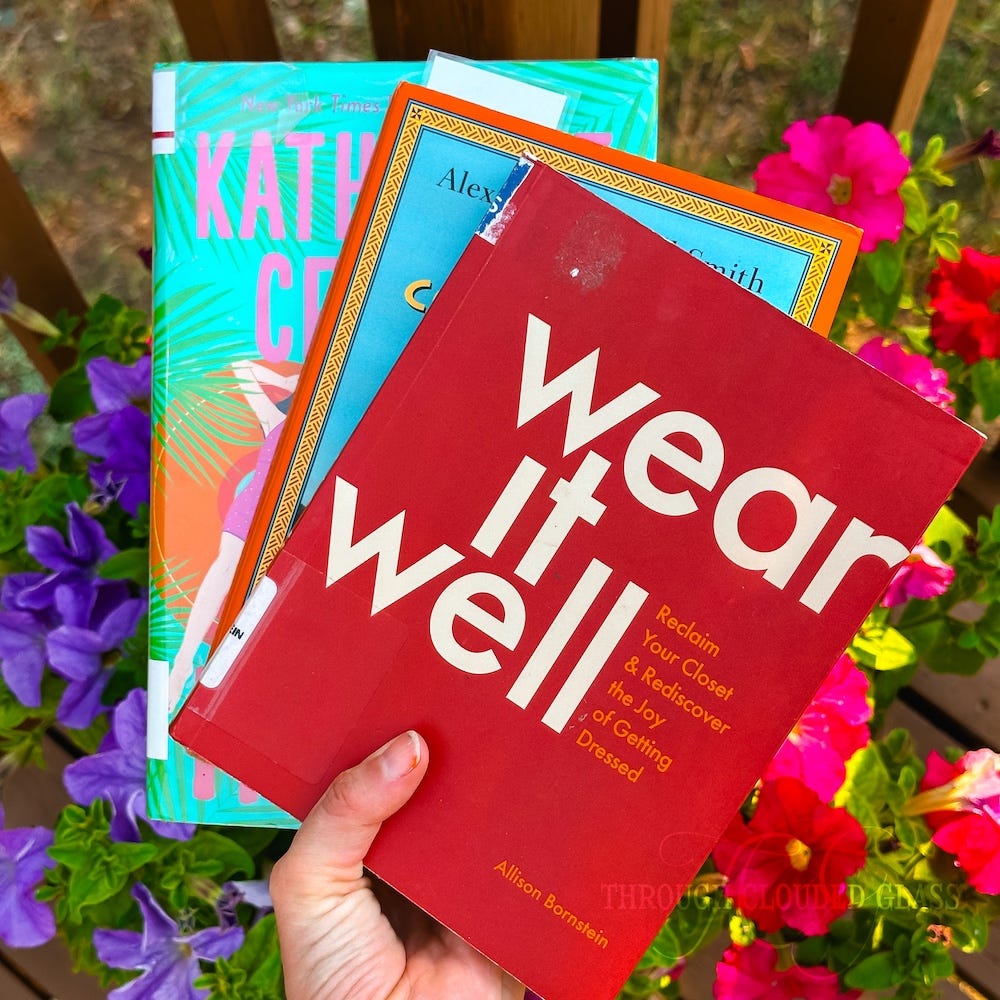
The Love Haters by Katherine Center
A friend got me hooked on Katherine Center a couple years ago. Every book I’ve read from her is like an early 2000s rom-com movie in book form! This one is about a documentary filmmaker, who must produce a promo for the National Coast Guard. The only problem is that she can’t swim, and can’t stand to see herself in a bathing suit…but somehow still ends up thrown together with a handsome coast guard rescue swimmer.
A large theme of this book was about body positivity and learning to appreciate your body - which was a bit heavy-handed, but didn’t keep me from enjoying the story. I also liked how all the characters had a nice ending in this book - Katherine Center always gives her books a happy ending, but even the unlikable characters end up with something good in this one.
Occasionally Center’s books can have a bit of content that I don’t appreciate, but this book had less of a need for content notes than some of her others (see below). Overall, this was probably one of my favorites from her!
Content Notes: Some cursing (including a few uses of the f-word), we find out two side characters slept together, mentions of characters living together in the past, etc.
Bottom Line: Pick it up if you enjoy old-school rom-coms.
In The Company Of Cheerful Ladies by Alexander McCall Smith
This is book six in the No. 1 Ladies’ Detective Agency series, which is basically my before-bed, comfort-read series. In this one, Mma Makutsi starts taking dancing lessons and meets an awkward man to whom she feels obligated to be kind - but she ends up being surprised by him in the end. One of the apprentice mechanics quits the shop, and Mma Ramotswe’s former husband shows up threatening to cause trouble for her.
Smith does a wonderful job of weaving all these story elements together throughout the book. What I like most about these books is that most of the problems are serious but not life-ruining, and the characters admire and respect each other as they figure out solutions. There is a fondness among all of the characters that is just comforting to read. This book was more of what I enjoy about this series. Highly recommend for a night-time read.
Content Notes: Infidelity of some of the villains/side characters.
Bottom Line: If you need a calm-down book before going to sleep, this series might be it.
Wear It Well: Reclaim Your Closet and Rediscover the Joy of Getting Dressed by Allison Bornstein
At the beginning of the year I shared some of the reading challenges in which I’m participating, and I decided to shift one of my 5x5 categories to include books about clothes and style. I’ve been wanting to make better use of the clothes I have and learn to appreciate my closet instead of adding new things constantly, and Wear It Well has been a great inspiration book for that.
This book opens with encouragement for cleaning out your closet, and then learning to edit your closet according to three words that you must choose to describe your style. Bornstein also gives us her nine closet staples, but the way she gives recommendations leaves so much room for you to interpret those pieces in a way that fits with your own style.
I really love the idea of trying to sum up one’s style in three words, and using those words to help you narrow the choices when cleaning out your closet or shopping for new clothes. It’s something I’ve been keeping in mind as the stores roll out their fall offerings, appreciating a garment while being able to say “it’s not for me”.
Bornstein gets a little “woo woo” in certain parts of the book - for example, near the end she recommends setting up a style “altar”, which is just bizarre and New Age-y. No, thank you. However, aside from religious/philosophical differences, I found this book really helpful and encouraging for defining my own style and figuring out ways to use all my clothes in a way that is unique to me. I’d recommend it, just keep in mind you might need to gloss over a couple weird elements.
Content Notes: Weird religious elements here and there (see above).
Bottom Line: If you enjoy fashion and are trying to hone your style, this would be a good place to start.

This summer has been odd when it comes to reading. I haven’t read nearly as much as I usually do, and the books in this post might be partially why. My summer reading rhythm was thrown off by two books with endings that left me severely annoyed and maybe I just lost my confidence in what to pick next.
I’m just now getting back on track, so come back next week for better recommendations. Read on if you want to see which books irritated me so much.

Old-Fashioned On Purpose by Jill Winger
I picked this book up on a whim, and ended up finishing it on audio. It’s written by a homesteading blogger, and I enjoyed reading how she runs her farm, home life, and businesses with an old-fashioned perspective (or at least as old-fashioned as you can be when your business is largely online). I especially enjoyed her thoughts on cooking and developing in-person community, and I gained an excellent recipe for homemade all-purpose cleaner! If you would like inspiration or direction on developing old-fashioned skills, this is the book to read.
Content Notes: Nothing significant.
Bottom Line: Interesting read if you are into modern homesteading and old-timey things.
Doomsday Book by Connie Willis
Okay, this is going to be a longer one, because I have to explain why I didn’t like this book. I have been enjoying some of Connie Willis’s books in the past year, and thought I would try this time travel series. In this book, set sometime in the future, historians don’t just study historical texts - they travel back in time and observe history first hand (intriguing, right?). Many dangerous centuries have been closed to time travel, but the 1300’s just opened, and Kivrin, a young historian, travels back to 1320…except something goes wrong. Meanwhile her friends back at home are dealing with an epidemic and other catastrophes that are preventing them from getting Kivrin back from the Middle Ages.
Alot of this plot revolves around The Black Death, and when people start dying of the plague, alot of existential questions are raised about the existence of God, suffering, etc. Kivrin doesn’t believe in God’s existence and thinks some blasphemous things about God, while some in the Middle Ages have their faith strengthened by her presence there.
As her friend (Mr. Dunworthy) is trying to get her back, he starts thinking in analogies of God sending Jesus, and the people on earth crucifying Him. In Dunworthy’s version of God, God watches helplessly and can’t do anything about it, and Jesus, who just wanted to help the people, dies for no reason. So Dunworthy reflects a “god” who is impotent, Kirvin reflects a “Jesus” who helps people by caring for them but can’t heal their suffering in any way, and the town priest who believes Kivrin is a saint that has come to ease their way to Heaven is misguided.
I was hoping for more clarification or depth in the ending, but Willis leaves these questions and distorted views of God unresolved by the end of the book. The meaning in the end seems to be since God doesn’t exist or can’t stop bad things from happening, all we can do is take care of each other in bad times.
There is one comment from a young boy in the story that attempts to give some meaning to all this tragedy. Kivrin is relating how the town priest believed she was a saint that God sent from Heaven to help them in the plague, and the boy comments that is what she did - because she was there, no one had to die alone or be left unburied. The comment feels like a bone thrown to readers of faith, but in the end the people are all still dead, aren’t they? And that seems to be the point of the book. This book was a tragedy with no real comfort or answers, and the blasphemy and distortions of God’s character made the message of this book neither good nor true. So this was not one I’d recommend.
Additional Content Notes: A character comes across a couple fornicating in the Middle Ages timeline, lots of death.
Bottom Line: Would not recommend, unless you don’t care about my problems outlined above and want an interesting way to be depressed.
Devolution: A Firsthand Account of the Rainier Sasquatch Massacre by Max Brooks
Ah, another book I can’t recommend.
I decided to listen to this book after hearing a homeschool influencer speaking about it. The synopsis sounded intriguing, and she was saying that this book had a really realistic portrayal of marriage - particularly how two people can kind of drift apart, but also how that drift can be reversed. In her defense, she was only partway through the book when it was mentioned, and a lot of the problems I’m going to talk about happened in the last quarter of the book.
As the story opens, our main character has started to treat her unemployed husband in a patronizing way, sometimes embarrassed of him. They move to a modern, minimalist community deep in the Washington woods that relies heavily on modern technology. When a volcano erupts nearby, their technology-run community is cut off from the rest of the world, and the residents learn that Bigfoot may not actually be a myth.
I did indeed find the initial portrayal of the apathy that can develop in marriage pretty realistic. The wife clearly loved her husband but struggled with looking down on him. I was interested to see how their relationship dynamic might change as they started facing this crisis, and that’s what ultimately kept me reading.
Spoiler ahead.
There were hints of the wife seeing her husband in a new light as he takes initiative to help the other residents, but unfortunately it was never fully fleshed out. In the end (spoiler), the husband lays down his life to save his wife and another resident. The grief that such an event would bring was not explored very much, and she doesn’t ever consciously recognize that she lost a good man that was very worthy of all her respect. Instead, the wife pushes her grief aside and becomes a vicious killer who leaves the community, presumably to hunt down the remaining creatures who killed her husband. We are left with the implication that she has left some of her humanity and become her own kind of monster.
I found myself so disappointed, and very annoyed, with this ending. There could have been such a beautiful underlying message about marriage, and it would have made the book into something more than just a gratuitous Bigfoot horror story. Instead the marriage aspect of the story is lost completely and we’re left with a post-modern, evolutionary worldview dragging the ending down. I just can’t tell you how bummed I was. It could have been so good.
Additional Content Notes: Evolution assumed, homosexual couple, lots of cussing, VERY gruesome descriptions of deaths (in the last quarter of the book).
Bottom Line: Overall, would not recommend, unless you want to dwell on the brutality of nature and gruesome death.
I went back to my old standby genres after these books made me regret branching out, so I’ll share a few winners soon! Expect several book posts in the next couple weeks.
What is the best book you’ve read this summer?
Subscribe to:
Posts (Atom)


